
A small crack, severe yellowing, or teeth that have been missing for years – each one tells a completely different story about your oral health. Treating them all with the same one-size-fits-all full-arch implant approach is one of the most common mistakes in dental tourism. At Saigon Crown Dental, we start by listening carefully to what your bite is actually missing. This guide will help you understand full mouth rehabilitation properly, and find the specific solution for your case
What is Full mouth rehabilitation?
Many clinics use “full mouth rehabilitation” to mean one thing: implants placed in both jaws. That’s a misunderstanding that leaves a lot of patients hesitant, because it makes it sound like treatment means removing every remaining tooth and starting over from nothing.
In real clinical practice, a genuine full mouth rehabilitation plan is a process of preservation and reconstruction – one that flexibly combines four groups of solutions, based on exactly what your bite actually needs.
|
Treatment Group |
Applies When You Have |
Corresponding Solutions |
|
Tooth Restoration |
Chipped, cracked, or badly decayed teeth; weakened root-canal-treated teeth |
Crowns, Inlays & Onlays, Bridges |
|
Cosmetic Restoration |
Discoloration, uneven shape, a gummy smile |
Veneers, Smile rehabilitation |
|
Tooth Replacement |
One missing tooth, several missing teeth, or a full arch |
Dental implants, Implant-supported crowns/bridges |
|
Functional Rehabilitation |
Significant tooth wear, a misaligned bite, jaw joint pain |
Tooth wear rehabilitation, Occlusal rehabilitation, Full-mouth restorative planning |
Most patients who come to us actually need two or more of these groups at once – for example, replacing a few missing teeth (Tooth Replacement) while also correcting a worn-down bite (Functional Rehabilitation). The next four sections will help you work out exactly where you stand.
Common cases that need Full mouth rehabilitation
Group 1 – Tooth restoration: restoring damaged teeth
This group applies when your natural teeth are still there, but the structure has been damaged beyond what a simple filling or polish can fix. The most common causes are teeth chipped or cracked from an old injury or years of heavy chewing, deep decay that’s spread close to the nerve, or a tooth that’s become brittle and prone to further cracking after root canal treatment.
Depending on how much damage there is, the solution is usually one of the following:
- Crowns cap the entire tooth when there isn’t enough healthy structure left for a filling
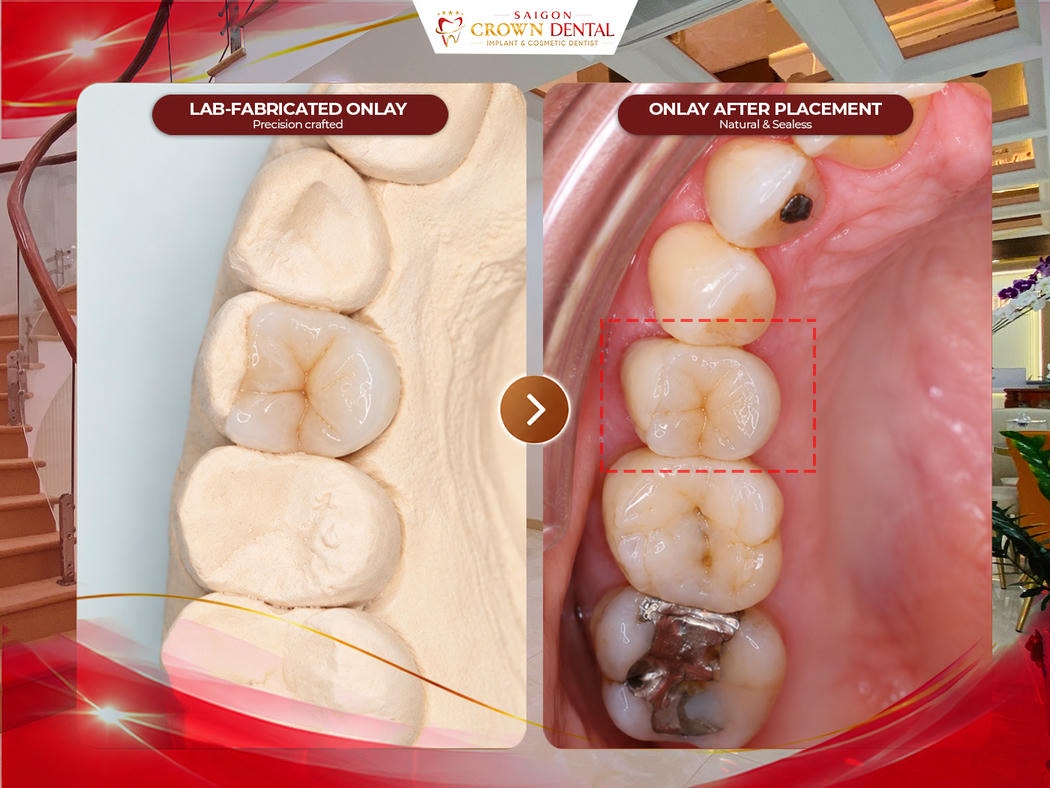
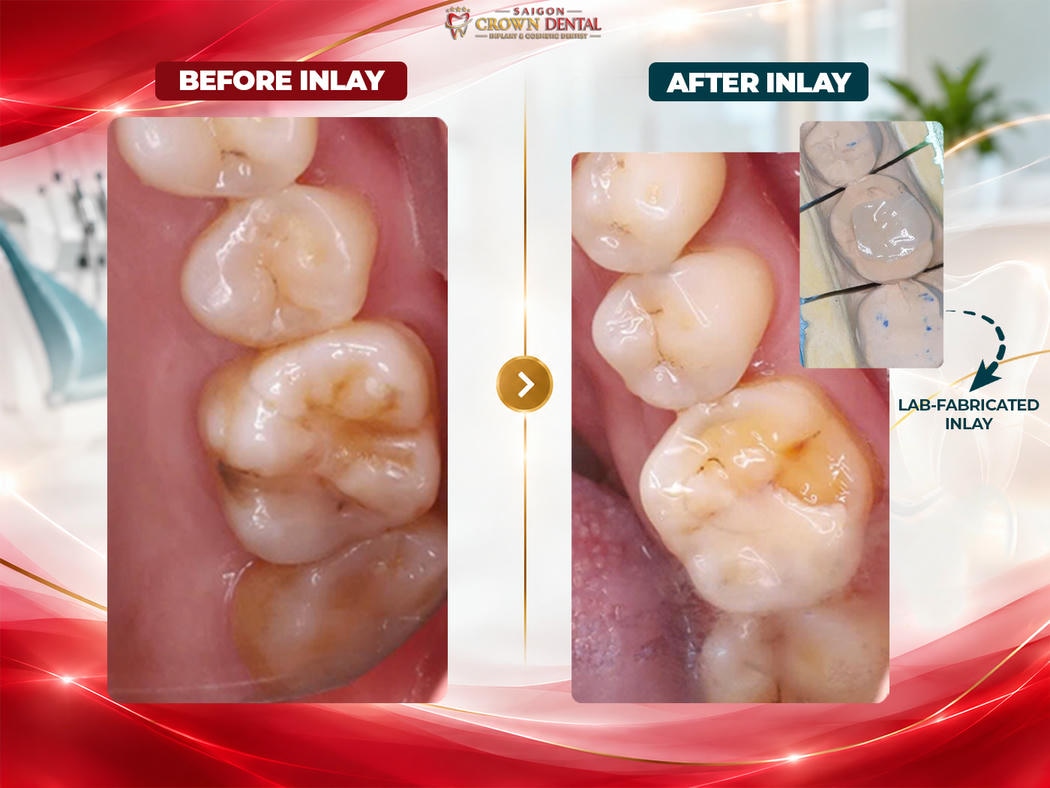
- Inlays and onlays restore part of a tooth when the damage hasn’t spread across the whole surface, preserving more of your natural tooth than a full crown would
- Bridges replace a few missing teeth in a row by anchoring to the healthy teeth on either side
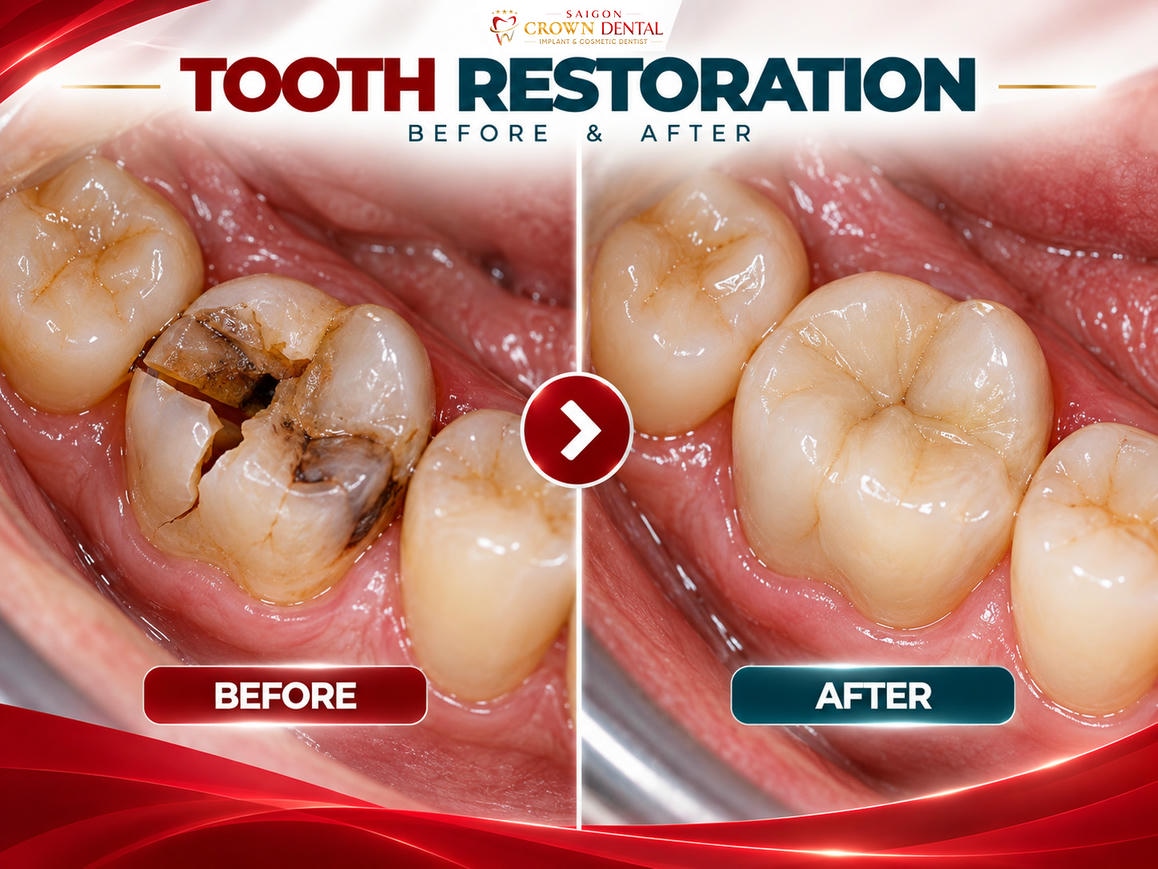
Because preserving your natural tooth structure is the priority, your dentist will generally recommend an inlay or onlay before considering a full crown – that’s the clinic’s standard, not the exception.
Group 2 – Cosmetic restoration: Restoring the smile
This group is for teeth that function just fine but don’t meet your aesthetic expectations – discoloration that whitening can’t touch, uneven shapes, noticeable gaps, or a gummy smile. These patients are usually looking to redesign the whole smile, not fix one or two small things.
The main solutions are:
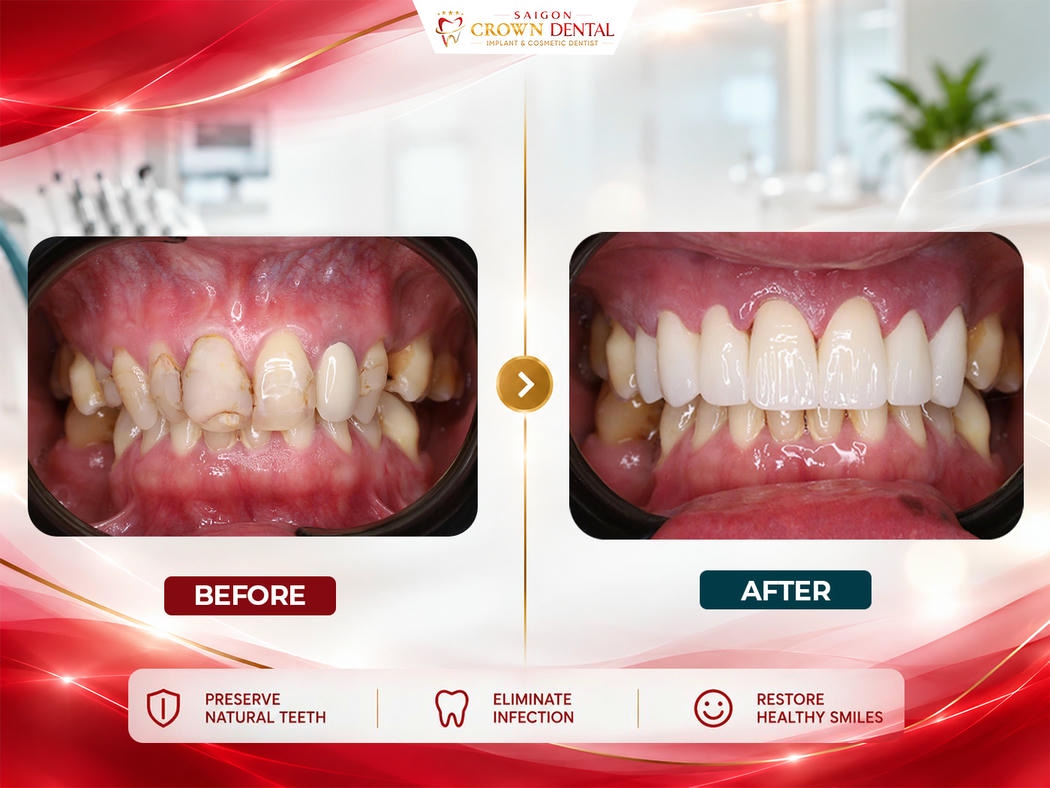
- Veneers – ultra-thin porcelain shells bonded to the front of your teeth that change color and shape without removing much natural structure
- Smile rehabilitation – a broader plan that combines veneers with gumline and proportion adjustments to redesign the smile as a whole, not tooth by tooth

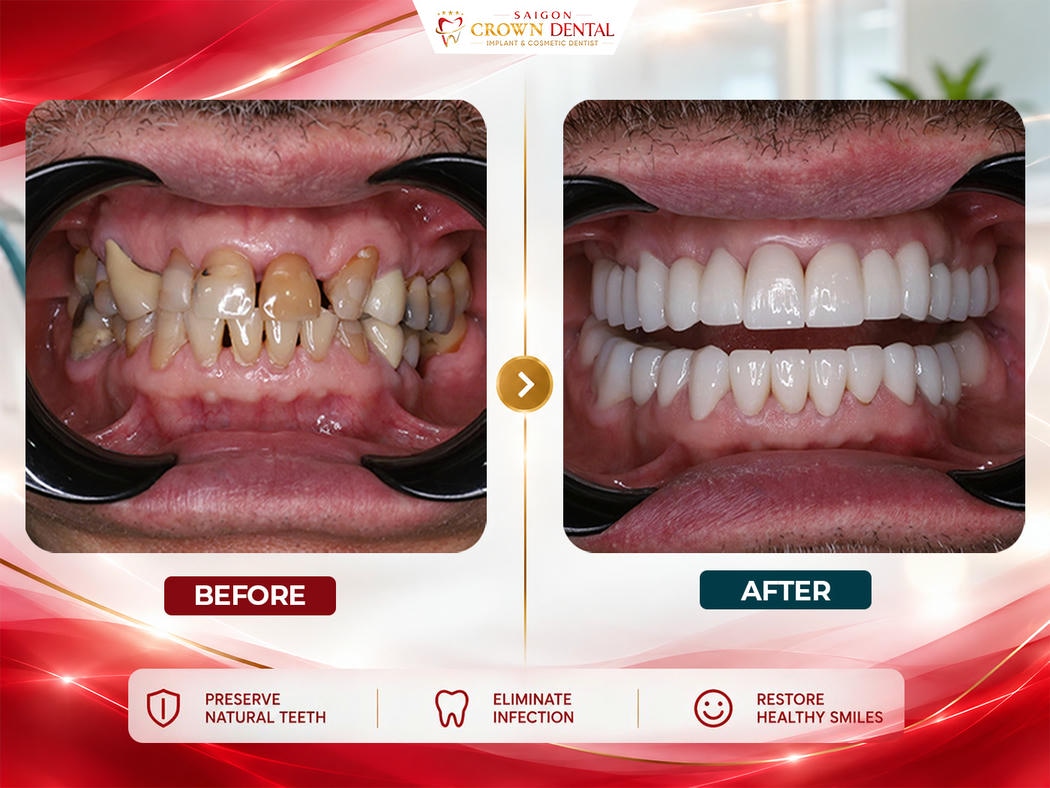
One case captures this well: a patient came in with worn, uneven, discolored teeth and left with a natural, evenly proportioned smile – with function restored first, and aesthetics built on top of that, not instead of it.
Group 3 – Tooth replacement: Replacing missing teeth
This group applies once teeth are actually gone – one, several, or an entire arch – and there’s no natural structure left to restore, only a gap that needs filling.
For one or a few missing teeth, that’s usually a single dental implant or an implant-supported bridge, depending on how many teeth and where they are.
For a fully or near-fully edentulous arch, your dentist will recommend one of three full-arch implant techniques:
- All-on-4 – four implants, the least invasive option, suited to patients whose jawbone density is still reasonably good
- All-on-6 – six implants, with stronger load-bearing (around 95% of natural bite force), suited to patients with more bone loss

The process for full-arch implants at Saigon Crown Dental is split into two stages, separated by the time it takes for the bone to fuse with the implants:
Stage 1 – implant placement, plus a reinforced temporary bridge so you can eat normally right away.
Then comes a 4–6 month waiting period while the bone fully integrates – you keep eating normally on your temporary bridge the entire time.
Stage 2 – your final, fixed restoration.
Group 4: Functional rehabilitation: Restoring how you actually chew
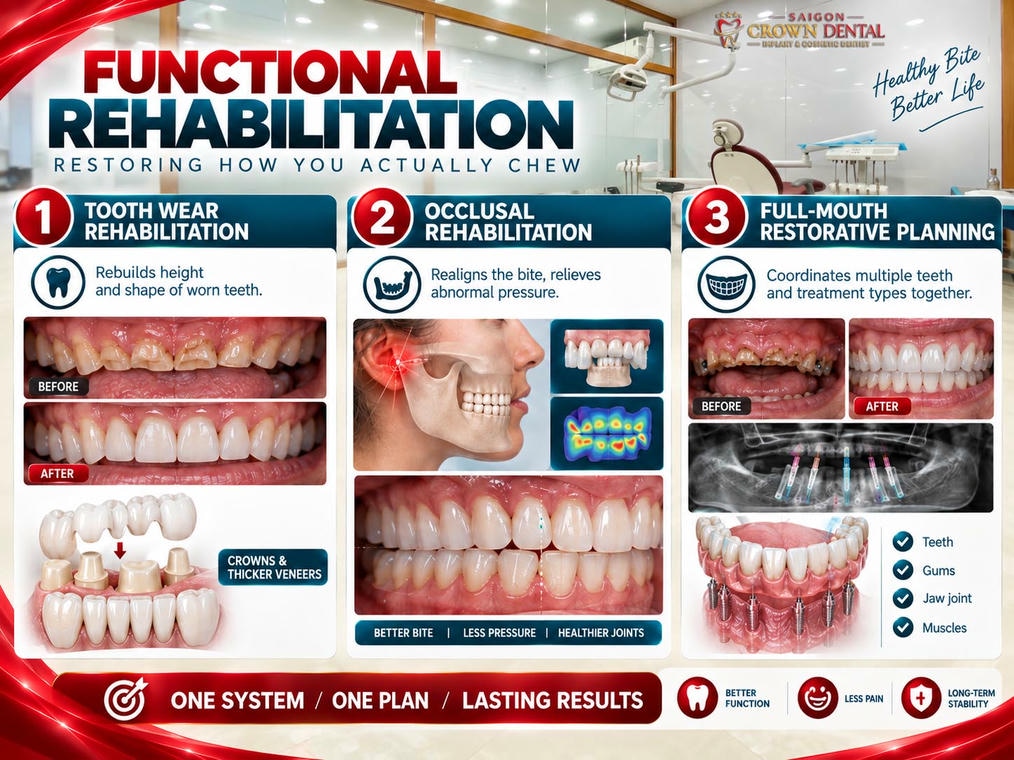
The first three groups generally solve problems tooth by tooth – restoring one, brightening another, replacing one that’s missing. Group 4 is different: it addresses the entire chewing system – teeth, jaw muscles, and the jaw joint – working together.
A lot of people assume that jaw pain or worn-down teeth just need a filling here or a crown there. But once the whole bite system has broken down, treating it piece by piece tends to fail. This is the most advanced level of restorative dentistry: addressing a chewing system where the teeth, muscles, and jaw joint are out of sync together. The problem isn’t one decayed tooth – it’s the entire bite landing in the wrong place, under the wrong pressure, and that’s what causes widespread wear or ongoing muscle and joint pain.
Solutions in this group include:
- Tooth wear rehabilitation – rebuilding the height and shape of worn teeth, usually with crowns or thicker veneers across several teeth at once
- Occlusal rehabilitation – realigning the bite so your upper and lower jaw meet correctly, taking abnormal pressure off your teeth and jaw joint
- Full-mouth restorative planning – coordinating multiple teeth and multiple treatment types together, to rebuild structure and function at the same time
The quick way to tell which group applies to you:
- One damaged tooth → Group 1, Tooth Restoration
- You want a whiter, more even smile → Group 2, Cosmetic Restoration
- You’re missing one or more teeth → Group 3, Tooth Replacement
- You can’t chew comfortably because of worn-down teeth, a sensitive bite, sore jaw muscles, or jaw joint pain → Group 4, Functional Rehabilitation
Full mouth rehab signs
If you’re still not sure which group applies to you, this self-check can help before you see a dentist. More importantly, understanding the risk of waiting is what protects your smile before small damage turns into something much harder to fix.
|
What you’re actually noticing |
Likely treatment group |
Risk if you leave it too long |
|
A large chip, crack, or severe decay, but the tooth root is still intact |
Tooth Restoration |
A small crack keeps spreading toward the root; decay that reaches the nerve often ends in infection or extraction instead of a crown or onlay |
|
Heavy discoloration, gaps, uneven shape, or wanting a better smile overall |
Cosmetic Restoration |
Long-term yellowing often goes hand-in-hand with thinning enamel, which makes teeth more sensitive to hot, cold, and everyday wear |
|
One missing tooth, several missing teeth, or a fully missing arch |
Tooth Replacement |
Neighboring teeth drift into the gap, your bite gradually shifts out of alignment, and the jawbone under the gap keeps resorbing – which is also what causes premature facial sagging |
|
Significant tooth wear, a misaligned bite, or aching jaw muscles/TMJ pain |
Functional Rehabilitation |
Tooth wear and bite misalignment never stop on their own – left alone, they accelerate, reduce facial height over time, and can turn occasional discomfort into chronic TMJ pain |
|
Two or more of the above at once |
A combined full mouth rehabilitation plan |
When problems overlap, each untreated area adds pressure to the others – which is exactly why combined cases need earlier intervention, before treatment becomes far more complex and costly |
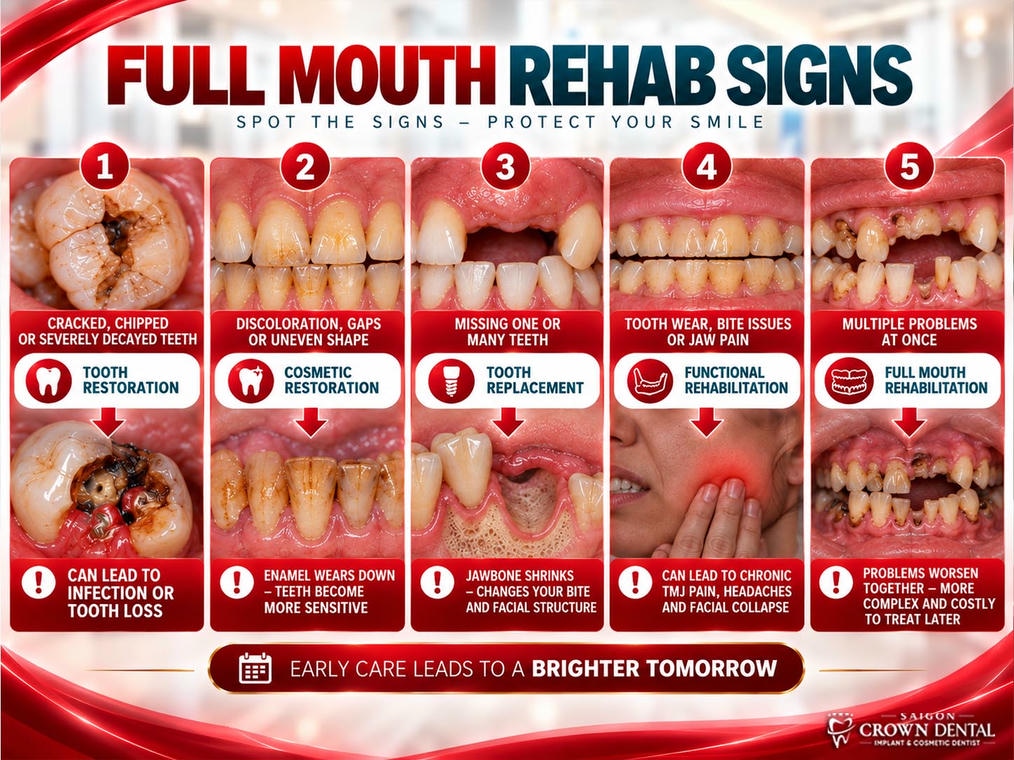
Most of the complex cases international patients bring to us fall into that last row – which is exactly why the initial exam and treatment plan matter more than any advertised price.
Common concerns for international patients
Before booking a flight, almost every international patient runs through the same list of questions in their head. Here are the ones we hear most, and how we answer them.
|
Concern |
What you’re actually asking |
How Saigon Crown Dental addresses it |
|
Safety & sterilization |
Is the clinic as sterile as one back home? |
Operates under AAMI standards and Vietnam’s Ministry of Health regulations |
|
What happens after you fly home |
If something goes wrong with my implant once I’m back, then what? |
A warranty policy with a remote follow-up process |
|
Number of trips required |
How many times do I need to travel, and for how long each time? |
A clear timeline given at your very first consultation |
|
Materials & technology |
Which implant brand, and where is the lab work done? |
Implant brands and CAD/CAM technology are disclosed upfront |
|
Hidden costs |
Is the first quote the final price? |
A transparent price list with no surprise add-ons |
|
Pain & sedation |
Is sedation available, and how long is recovery? |
A clear pain-management plan explained before treatment starts |
Every one of these concerns gets a specific answer, not a vague reassurance – a fair standard to hold any clinic to, not just this one.
Does full mouth rehabilitation hurt?
Full mouth rehabilitation itself isn’t painful during treatment, thanks to modern anesthesia and sedation. What does vary is the soreness or mild discomfort afterward, and that depends on which group your treatment falls under.
Group 1 (Tooth Restoration – crowns, onlays, inlays):
You may feel mild sensitivity while your tooth is being prepared, or while wearing a temporary crown for the first few days. This is easily managed with standard over-the-counter pain relief.
Group 2 (Cosmetic Restoration – veneers):
The least invasive of the four, with almost no discomfort. You might notice brief, mild sensitivity in the gums or tooth surface for a day or two while you adjust.
Group 3 (Tooth Replacement – dental implants):
Expect some swelling, soreness, or mild pain around the surgical site once the anesthesia wears off. This typically eases and resolves within 3–5 days with the pain medication your dentist prescribes.
Group 4 (Functional Rehabilitation – bite reconstruction, wear correction):
You may notice mild jaw muscle soreness, or an unfamiliar feeling as your bite is raised to its corrected height. It usually takes one to two weeks for your muscles and jaw joint to fully adapt to the new bite position.
Some discomfort is normal and well within what your body can comfortably handle, but there’s no reason to expect severe pain when the procedure is done correctly and your dentist stays closely involved in managing it with you.
The treatment process at Saigon crown dental
The first step is always the same, no matter which group applies to you: a full exam, a 3D Cone Beam CT scan, and a digital scan to work out exactly which group – or combination of groups – your case falls into. From there, your dentist builds a detailed treatment plan.
That might fit into a single trip if you only need Tooth Restoration or Cosmetic Restoration, or it may be split across two trips if full-arch implants are involved, as described under Tooth Replacement above.
How many trips will you need?
For Tooth Restoration, Cosmetic Restoration, or a smaller Functional Rehabilitation case, one trip is usually enough – most of these treatments are completed within 3–5 appointments.
If your case involves full-arch dental implants, plan on two trips: the first for implant placement, and a second one 4–6 months later for your final, fixed restoration, once your jawbone has fully healed around the implants.
Real patient results
- Tooth Restoration


Dental cost comparison
|
Treatment Group |
Vietnam (estimate) |
US / UK / Australia (estimate) |
|
Crown / Veneer (per tooth) |
From $300 |
$1,000 – $2,500 |
|
Inlay / Onlay (per tooth) |
From $250 |
$800 – $1,500 |
|
Single implant |
From $800 |
$3,000 – $6,000 |
|
Full-arch implants (one arch) |
$8,000 – $15,000 |
$30,000 – $45,000 |
|
Full-arch implants (both arches) |
$15,000 – $28,000 |
$55,000 – $80,000 |
These are reference figures only, exclusive of VAT, and will vary depending on your actual condition after an in-person exam. Always ask for a written, itemized quote before you confirm your appointment.
What if something goes wrong later?
This is the single biggest worry in the entire journey, and it deserves the clearest answer of all.
If an issue comes up after you’ve returned home: you send photos or a video describing the problem via WhatsApp or email; the clinical team reviews it remotely and coordinates a temporary solution with a local dentist near you if needed; and if in-person treatment is required, the clinic helps you schedule a follow-up trip under the warranty terms.
This means you’re not left on your own once you leave Vietnam. That said, the exact warranty period and scope should be documented in writing as part of your treatment plan before you begin.
Hotels, transfers, and scheduling
Comprehensive Concierge & Travel Support for Your Dental Journey
Navigating medical care abroad involves more than just clinical appointments—your comfort, safety, and peace of mind during recovery are top priorities. Our end-to-end concierge services ensure a seamless, stress-free experience from the moment you land.
-
Seamless airport transfers:
You will be met directly at Tan Son Nhat International Airport (SGN) by a private holding , ensuring a smooth transition to your accommodation without the hassle of navigating local transit or hailing taxis while tired from a long flight.
-
Handpicked Partner Accommodations:
We partner with high-quality, highly-rated hotels located within very close proximity to the clinic. These hotels are chosen specifically for their cleanliness, quiet environments, and comfort, ensuring you have a relaxing, stress-free space to rest and recover after your procedures.
-
Chauffeur-Driven Appointment Logistics:
You won’t need to worry about booking rides or finding directions. Private transportation is fully arranged to pick you up from your hotel, bring you to the clinic for every single appointment, and return you safely afterward for the entire duration of your stay.
-
Personalized Itinerary & Scheduling:
Your treatment calendar is custom-built around your exact travel dates and flight schedule in Vietnam. We optimize your timeline so you have plenty of time for clinical procedures, rest periods, and even light sightseeing if you feel up to it, ensuring zero rushed appointments.
None of this replaces the dental plan itself – but for patients flying in from the other side of the world, it’s often what makes the difference between a stressful trip and a manageable one.
Why choose Saigon crown dental
Planning dental treatment abroad is a significant decision; therefore, finding a reputable and trustworthy clinic is essential to ensuring both your health outcomes and a smooth overall experience. At Saigon Crown Dental, we combine advanced technology, international standards, and a patient-centered philosophy to deliver the high-quality, effective results you expect. Here is why international patients choose us:
-
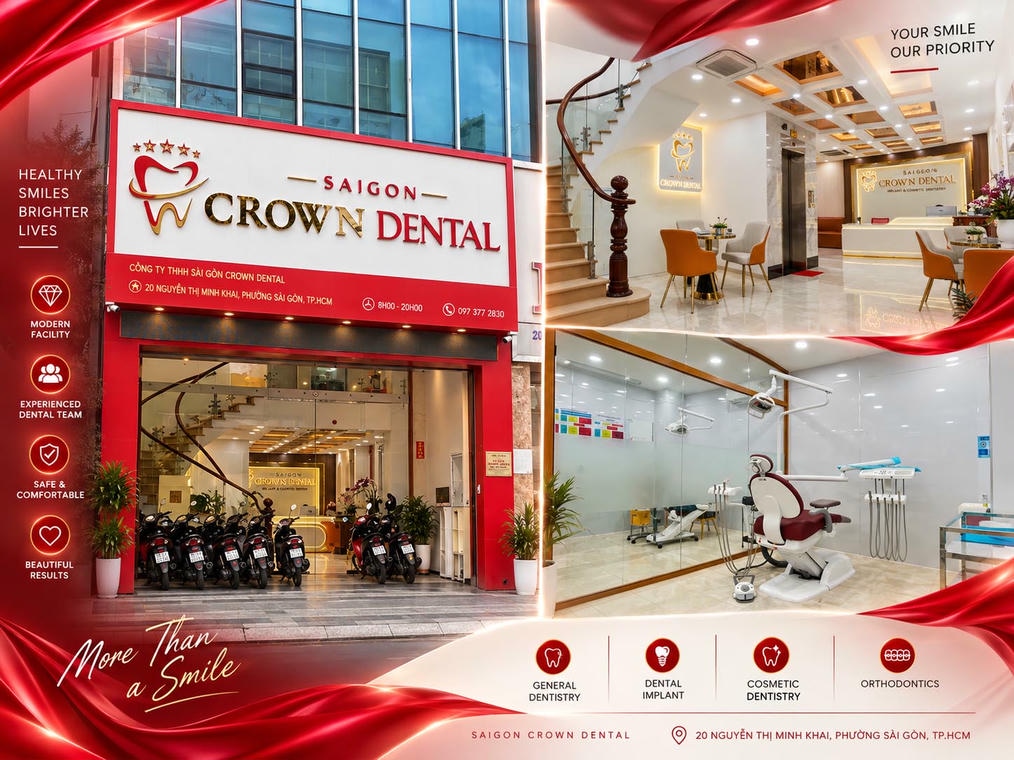
Prime District 1 Location:
Conveniently situated at, our clinic sits right in the heart of Ho Chi Minh City, just minutes away from major hotels, top dining, and city center attractions for effortless travel logistics.
-
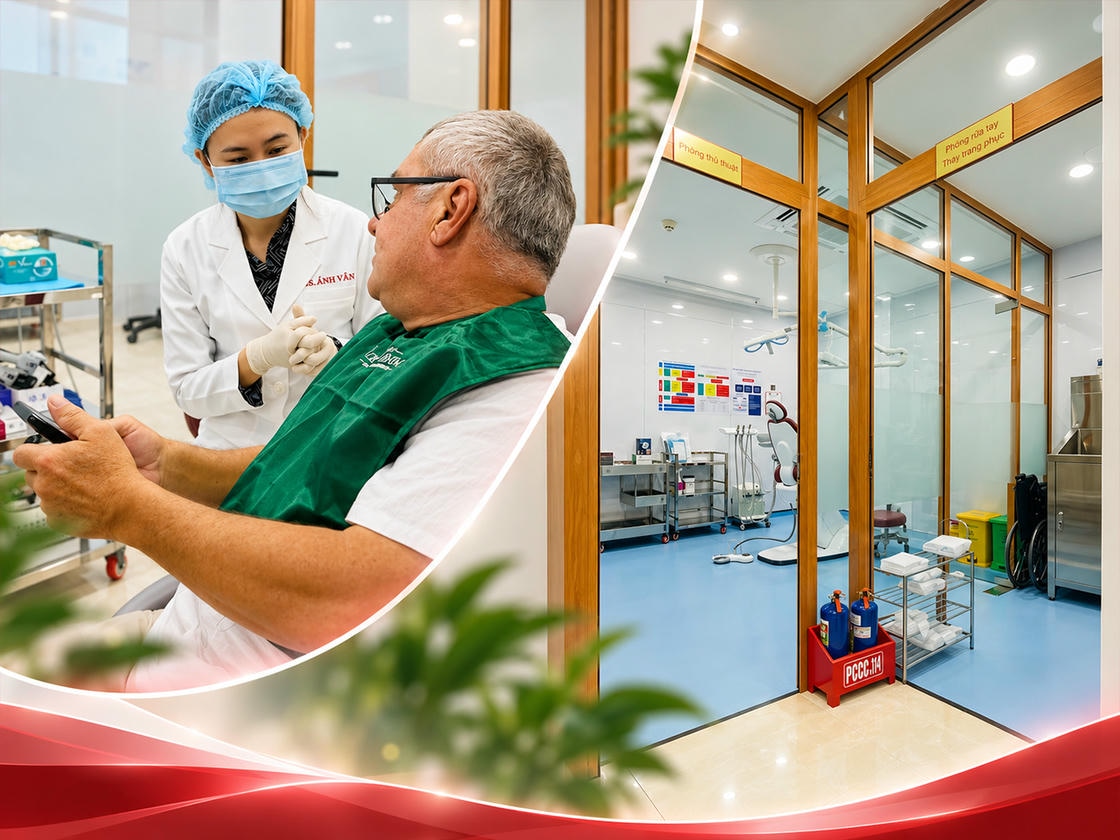
Clear English Consultations:
Communication is critical to your comfort. Your diagnosis and treatment options are explained directly, openly, and thoroughly in fluent English, ensuring complete transparency with zero language barriers or misunderstandings.
-
Expert Implant & Restoration Team:
Your smile is managed by a dedicated group of experienced dental surgeons and restorative specialists who collaborate closely to handle complex full-mouth cases from initial planning to final placement.
-
Trusted Global Track Record:
We have built a reliable, established reputation proudly serving international patients from over 10 countries, delivering dependable dental care and exceptional clinical outcomes year after year.
-
Millimeter-Accurate 3D Planning:
We remove the guesswork from surgery. Every implant procedure is digitally mapped out in advance using advanced 3D intraoral scanning and Cone Beam CT imaging to guarantee maximum safety and precision.
-
Precision CAD/CAM Restorations:
Your final crowns, bridges, and veneers are digitally fabricated using state-of-the-art CAD/CAM milling technology, achieving micron-level accuracy for a natural aesthetic and a seamless, comfortable fit.
-
Tooth & Bone Preservation First:
We believe in treating your natural smile with care. Our conservative clinical philosophy focuses on safeguarding and saving as much of your natural tooth and bone structure as medically possible.
Frequently asked questions
-
Do I need dental implants for full mouth rehabilitation?
Not necessarily. Depending on your case, you might only need Tooth Restoration or Cosmetic Restoration, with no tooth replacement involved at all.
-
Will I need to travel to Vietnam more than once?
It depends on your treatment group. Full-arch implants require two trips; most other groups only need one, depending on complexity.
-
What happens if I’m not happy with the result?
Your treatment plan and warranty terms are agreed in writing before treatment begins.
-
Does the dentist speak good English?
Yes – the lead dentist trained in the US and Brazil and consults with you directly in English.
Conclusion
This decision shouldn’t come down to the lowest price you find online – it should come down to whether you’ve actually been diagnosed into the right treatment group for your case. Send a recent photo of your teeth or your latest dental X-ray, and the team at Saigon Crown Dental will get back to you on WhatsApp with a preliminary treatment plan – free, no obligation.
SEND YOUR X-RAY FOR A FREE CONSULTATION ON WHATSAPP