
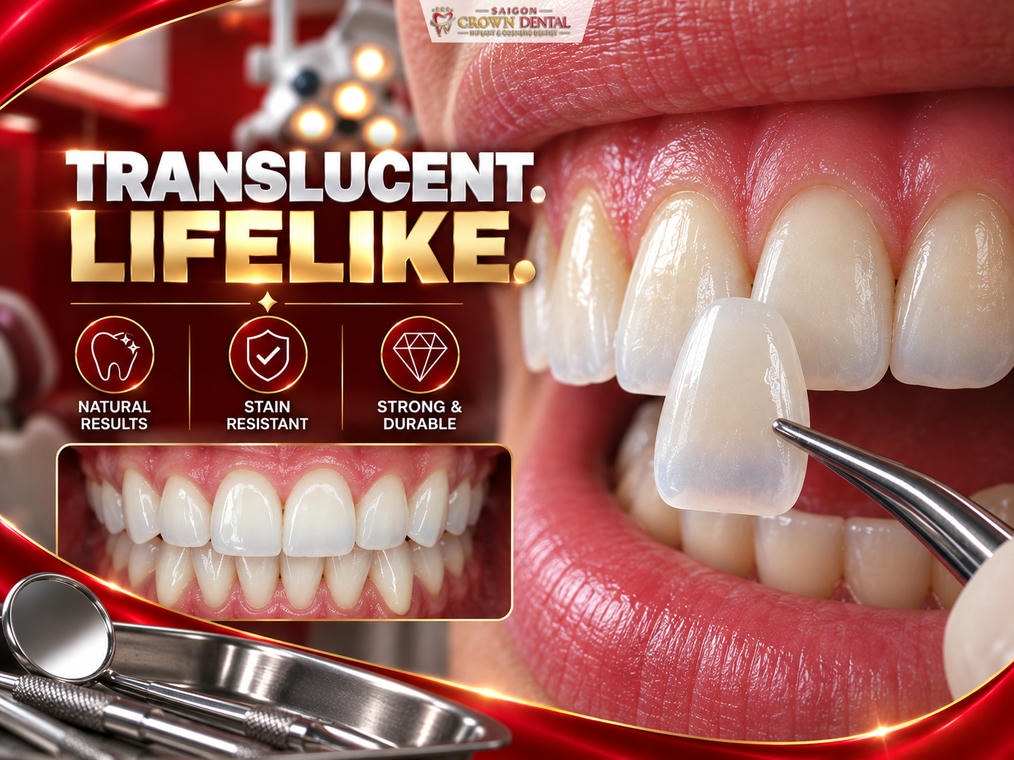
Porcelain veneers give you a genuinely beautiful smile without grinding down healthy teeth. That fear – losing real tooth structure – stops most people from booking treatment. If your teeth are healthy and you only want to improve how they look, you don’t need a full crown. At Saigon Crown Dental, each veneer is custom-designed with digital technology to suit your face, not a one-size-fits-all mold.
What Are Porcelain Veneers?
Porcelain veneers are ultra-thin ceramic shells. They are typically 0.3-0.7mm thick, custom-fabricated, and bonded directly onto the front surface of a tooth. As a result, they correct shape, color, and symmetry without removing most of the natural tooth structure the way a full crown does.
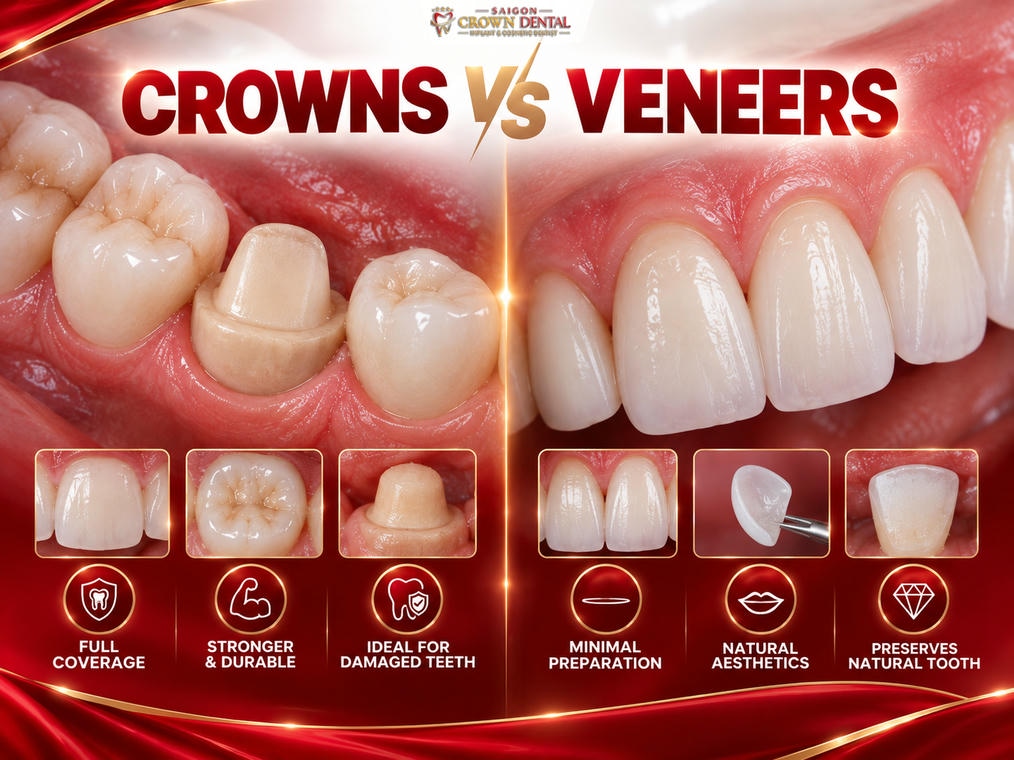
A crown wraps around the entire tooth. Therefore, it requires reduction on every surface to create a stable post. Veneers, by contrast, only involve the front-facing surface. Because of this, the healthy structure inside the tooth and on its sides stays almost completely intact – the single most important distinction to understand before committing to treatment.
Veneers vs Crowns: The Core Difference
This is the number one concern for international patients researching veneers, especially after the “Turkey teeth” trend went viral online – cases where healthy teeth were ground down into small stumps for zirconia crowns, while patients believed they were only getting minimal-prep veneers.
At Saigon Crown Dental, we put these commitments in writing before treatment begins.
We never switch from veneers to crowns without your explicit consent and a clear explanation beforehand.
We reduce only the minimum amount of tooth structure required for the original veneer plan.
If your teeth turn out to be unsuitable for veneers – weak, heavily decayed, or significantly misaligned – your dentist will recommend a more appropriate option honestly, even if that means less treatment than originally expected.
|
Criteria |
Porcelain Veneers |
Crown (Full Coverage) |
|
Area involved |
Front surface only |
Entire tooth |
|
Reduction depth |
Minimal (0.3-0.7mm) |
Significant (1.5-2mm all around) |
|
Retention mechanism |
Adhesive bond to enamel |
Mechanical retention around the prepared tooth |
|
Best suited for |
Healthy teeth needing cosmetic improvement |
Weak or heavily damaged teeth, root-canal-treated teeth |
|
Reversibility |
Irreversible, but minimally invasive |
Irreversible, more invasive |
How Porcelain Veneers Preserve Your Tooth
A common question is simple: if the tooth is filed down that thin, how can it hold up over time? The answer comes down to two things – precise control of the reduction, and how the ceramic bonds to what’s left of the enamel.
Before shaping begins, the dentist cuts shallow depth-guide grooves into the tooth. These grooves work as built-in stop lines. Specifically, they keep the reduction within the planned 0.3-0.7mm range, rather than going deeper than necessary – a sharp contrast to crown preparation, which typically removes 1.5-2mm around the entire tooth.
The finish line is usually a chamfer margin, placed level with or just above the gumline. This design lets the ceramic edge sit flush against the gum tissue without extending deep beneath it. As a result, irritation to the soft tissue stays minimal.
On the material side, veneers don’t rely on mechanical grip the way a crown does. Instead, Lithium Disilicate ceramic is adhesively bonded straight onto the remaining enamel with a dental-grade resin cement. Once that chemical bond sets, the enamel and ceramic behave almost as a single, continuous structure. That is why a shell this thin can still withstand normal biting forces, reaching a flexural strength of roughly 400 MPa- well within the range needed for everyday chewing loads (Source: American Dental Association).
Because of this controlled, minimal-prep technique combined with adhesive bonding, veneers tend to keep the tooth’s nerve healthier long-term. In addition, they noticeably reduce post-treatment sensitivity compared to deeper-cut restorations.
Common types of dental veneers:
-
Feldspathic porcelain veneers
The highest natural translucency, best for patients who prioritize maximum aesthetics.
-
E.max veneers (Lithium Disilicate)
The most widely chosen option, balancing strength and appearance.
-
Zirconia veneers
Higher strength, suited to patients who need extra reinforcement for chewing load.
Each type comes with a different thickness and reduction requirement. Your dentist will recommend the right one based on your dental condition and aesthetic goals, rather than defaulting to a single option for everyone.
Benefits of Porcelain Veneers
Beyond looking good, veneers solve several problems at once that other treatments would need multiple separate steps to address. Here’s what patients consistently value most.
Preservation and safety come first for most people once they understand the trade-offs involved. Since only a thin outer layer is touched, the tooth’s inner structure and nerve stay largely undisturbed – a meaningful difference from full-crown treatment.
Appearance and longevity matter just as much. High-grade ceramic mimics the translucency and light reflection of natural enamel. In addition, it resists staining far better than your real teeth do, even with regular coffee, tea, or wine.
Preservation and safety:
- Maximum tooth preservation – only the thin outer enamel layer is treated, keeping the inner tooth structure intact.
- Minimally invasive, less sensitivity – 3D Cone Beam CT, digital intraoral scanning, and DSD let the dentist plan every millimeter precisely.
- International safety standards – sterilization protocols meet AAMI, Vietnam’s Ministry of Health (MOH), and FDA guidelines.
Aesthetics and durability:
- Natural look, never “blocky white” – premium ceramic reflects light like real enamel instead of a flat, uniform shade.
- Stain-resistant, long-lasting color – the smooth ceramic surface resists discoloration better than natural teeth.
- High durability – with Lithium Disilicate ceramic and proper care, veneers typically last 10-15 years or longer.
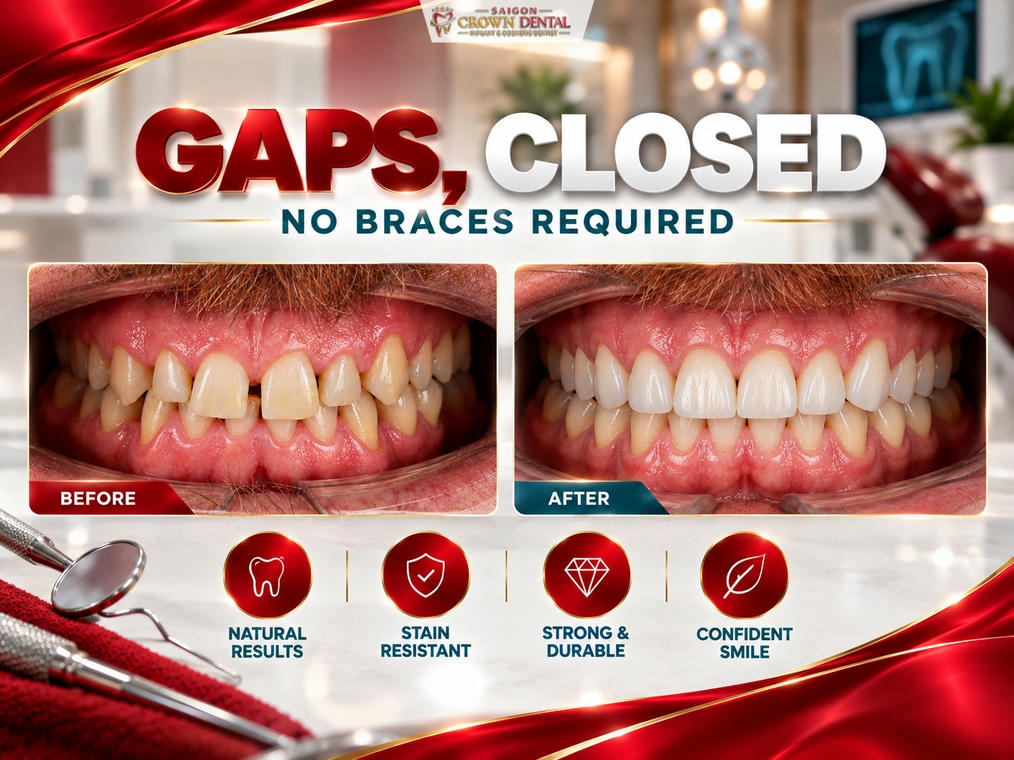
- Multiple corrections in one treatment – fixes discoloration, gaps, mild misalignment, and uneven shape without lengthy orthodontic treatment.
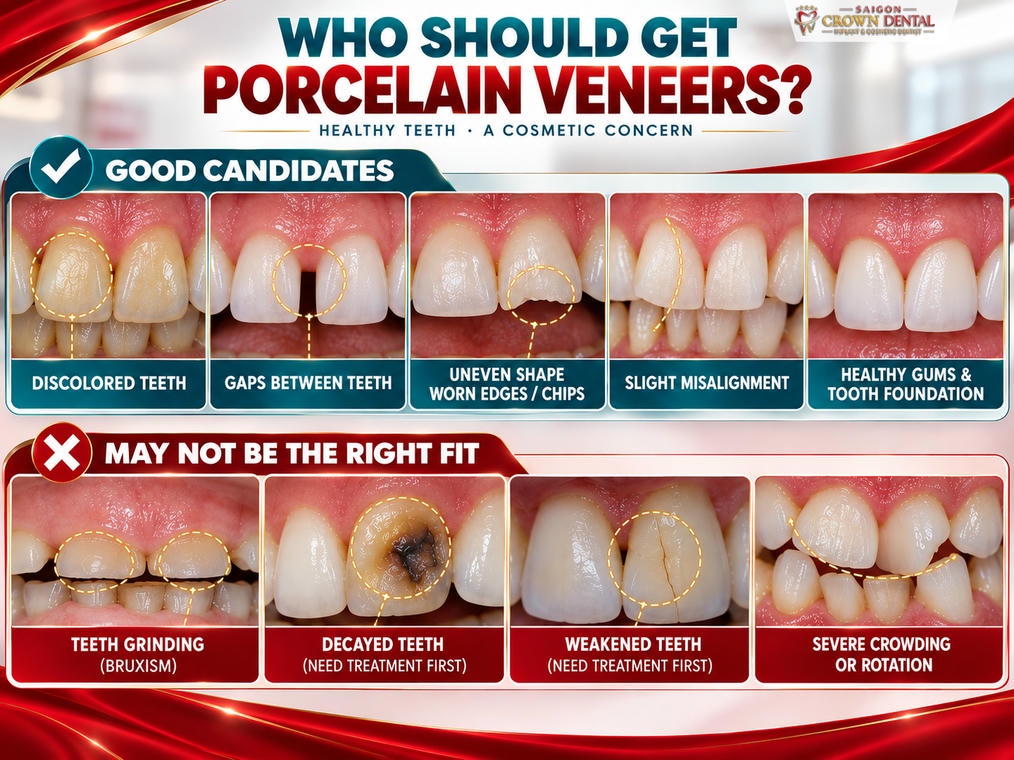
Who Should Get Porcelain Veneers?
Not everyone is a good candidate for veneers. Your dentist evaluates your overall oral health first, rather than simply agreeing to whatever the patient requests.
The best candidates usually have a healthy tooth foundation with a purely cosmetic concern:
- Yellowed or discolored teeth that don’t respond to regular whitening, or tetracycline-stained teeth
- Mild to moderate gaps between teeth that need a quick fix without orthodontic treatment
- Uneven tooth shape, worn edges, or minor chips affecting the smile
- Slight misalignment – veneers don’t replace orthodontics for severe crowding or rotation
- Healthy gums and tooth foundation, with no untreated decay or active gum disease
On the other hand, veneers may not be the right fit if you have uncontrolled teeth grinding, decayed or weakened teeth that need treatment first, or if a more conservative option – whitening or orthodontics – could achieve your goal. In those cases, your dentist will say so honestly, even when it means less treatment than originally expected.
What Happens If You Choose the Wrong Provider
This is the number one concern for international patients researching veneers – especially after the “Turkey teeth” trend went viral online. In several documented cases, healthy teeth were ground down into small stumps for full crowns, while patients believed they were only getting minimal-prep veneers.
At Saigon Crown Dental, we put these commitments in writing before treatment begins:
- We never switch from veneers to crowns without your explicit consent and a clear explanation beforehand.
- We reduce only the minimum amount of tooth structure required for the original veneer plan.
- If your teeth turn out to be unsuitable for veneers – weak, heavily decayed, or significantly misaligned – your dentist will recommend a more appropriate option honestly, even if that means less treatment than originally expected.
Treatment Process at Saigon Crown Dental
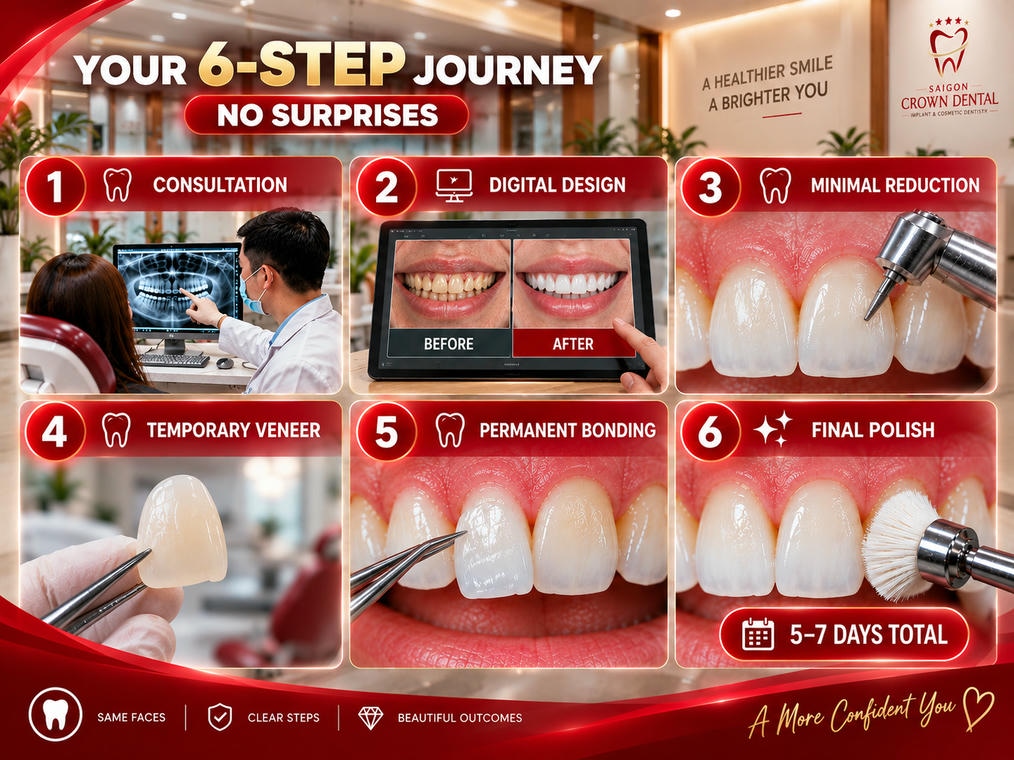
Before a single layer of enamel is touched, you preview the final result on your own face. This step is a required part of our process, not an optional add-on.
-
Consultation and diagnosis.
A clinical exam, digital X-rays, and an assessment of your teeth and gum foundation determine whether veneers are right for you.
-
Digital Smile Design (DSD) and mock-up approval.
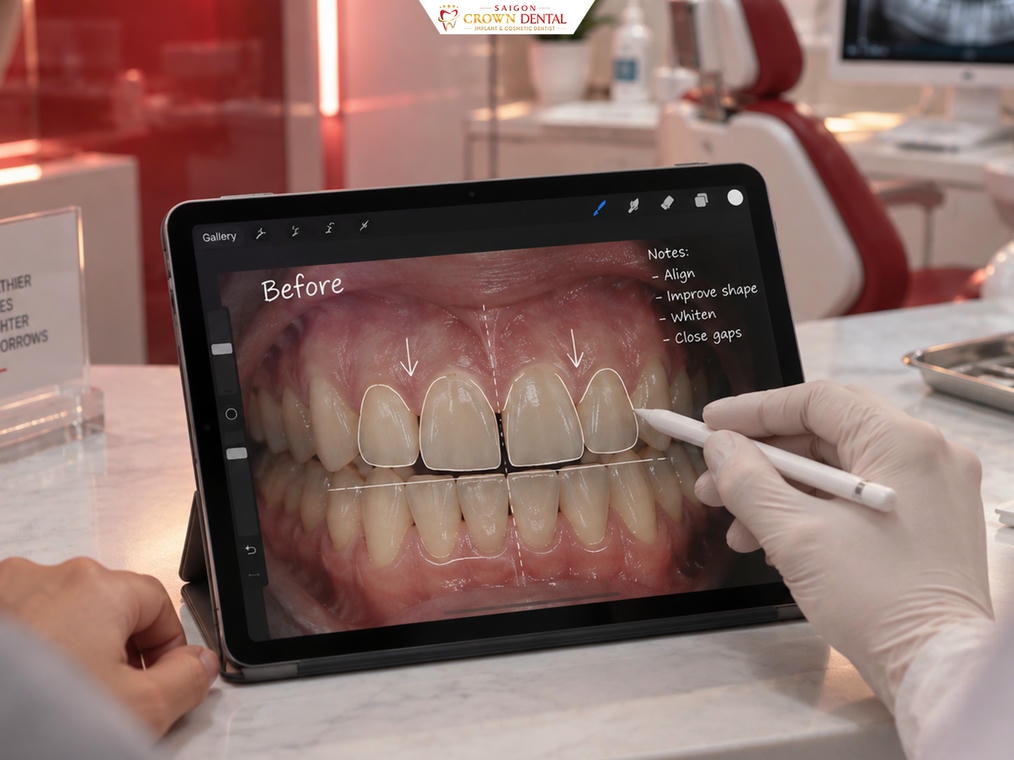
Your face and current smile are photographed and 3D-scanned. The dentist simulates shape, proportion, and shade on your facial structure, then you test and approve a physical mock-up in your mouth — before any reduction happens.
-
Minimal tooth reduction and 3D impression.
Only the thin outer enamel layer is reduced, following the approved design and depth-guide grooves. A digital 3D scan is then taken to fabricate the veneers precisely.
-
Temporary veneers.
These protect your prepared teeth while the lab fabricates your final ceramic restorations, usually within about 72 hours.
-
Fit check and permanent bonding.
Fit, proportion, and shade are checked against your natural teeth and fine-tuned before permanent adhesive bonding.
-
Final polish and bite check.
This ensures your bite feels natural and comfortable when chewing.
How Long Does Treatment Take?
Most cases are completed within 5-7 days. Tooth preparation and temporary veneers are placed on day one; permanent bonding follows a few days later, once the lab finishes fabrication. For patients on a tight schedule, the clinic can arrange an expedited timeline of about 4 days across 3 appointments – well suited to a short trip or vacation in Vietnam.
Real Patient Results
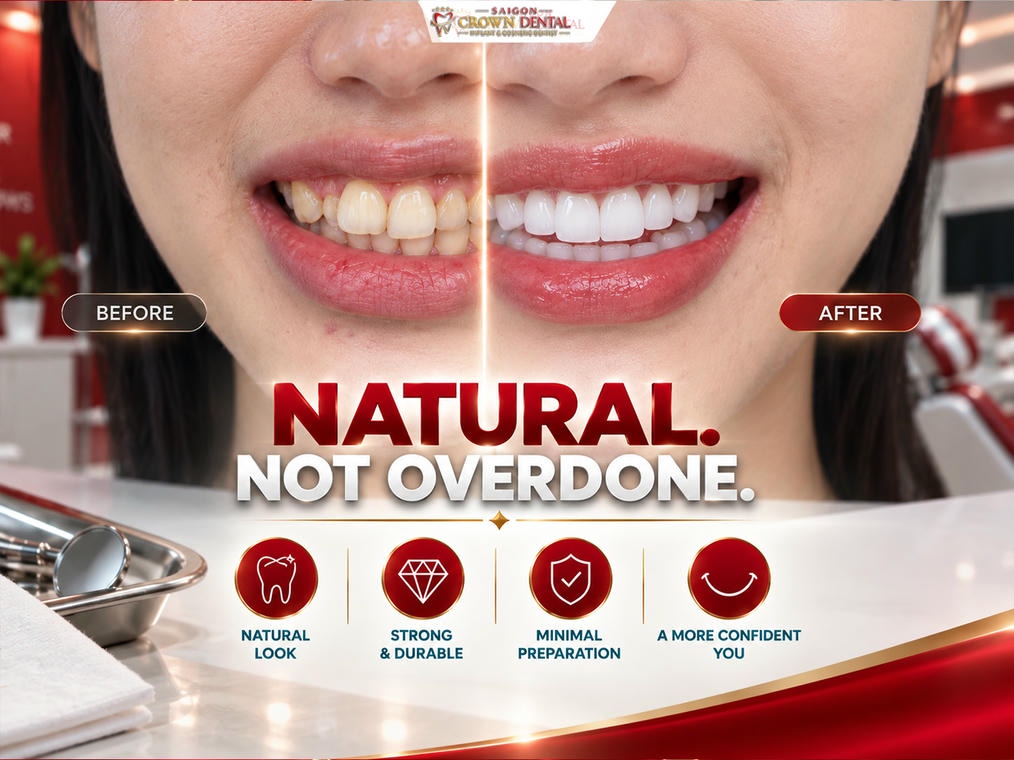
Every case photo in our gallery is unedited and reflects each patient’s actual result – a standard we maintain across our cosmetic dentistry practice in Vietnam. The portfolio spans a wide range of face shapes, skin tones, and age groups, not a single repeated template.
-
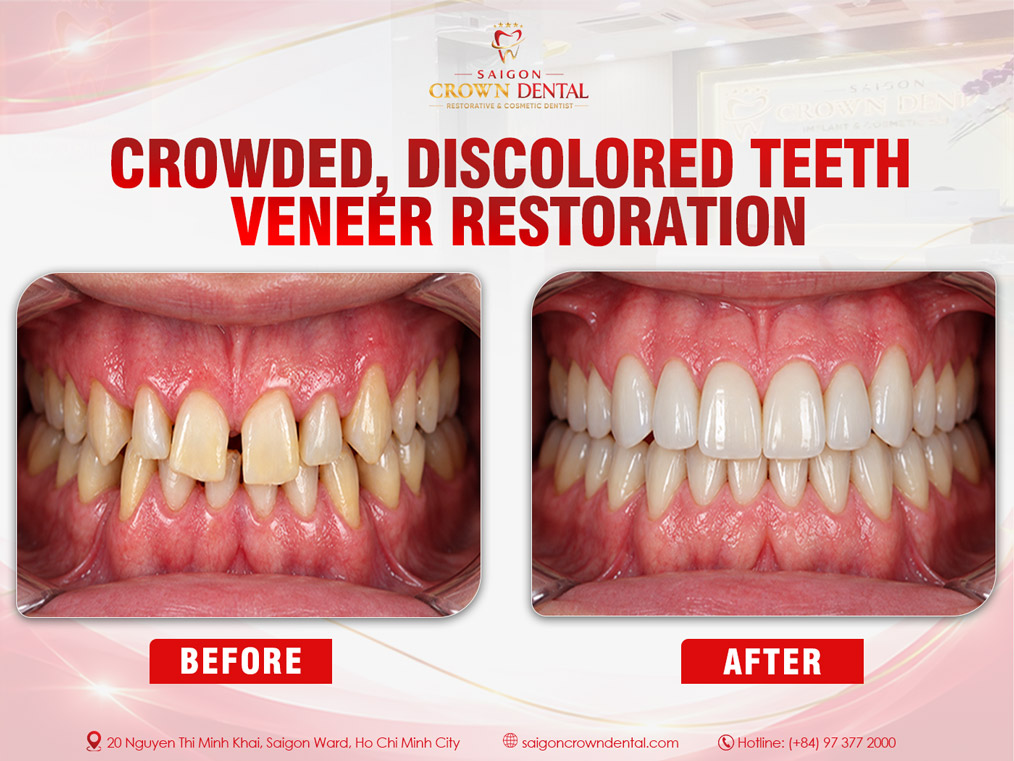
Case 1 – Crowded, discolored teeth veneer restoration (severe)
Severely crowded and heavily discolored front teeth with overlapping edges affected both alignment and shade. Porcelain veneers reshaped the crowded teeth and unified the color for a straighter, brighter smile.

-
Case 2 – Crowded, discolored teeth veneer restoration
Mild crowding combined with yellow – toned discoloration made the smile appear uneven. Veneers corrected the tooth alignment visually and lifted the shade to a natural white.
-
Case 3 – Mildly Discolored Teeth Veneer Restoration
Teeth showed light yellow discoloration with otherwise well-aligned, healthy-looking structure. A thin layer of porcelain veneers brightened the shade to a clean, natural white without changing tooth shape.

-
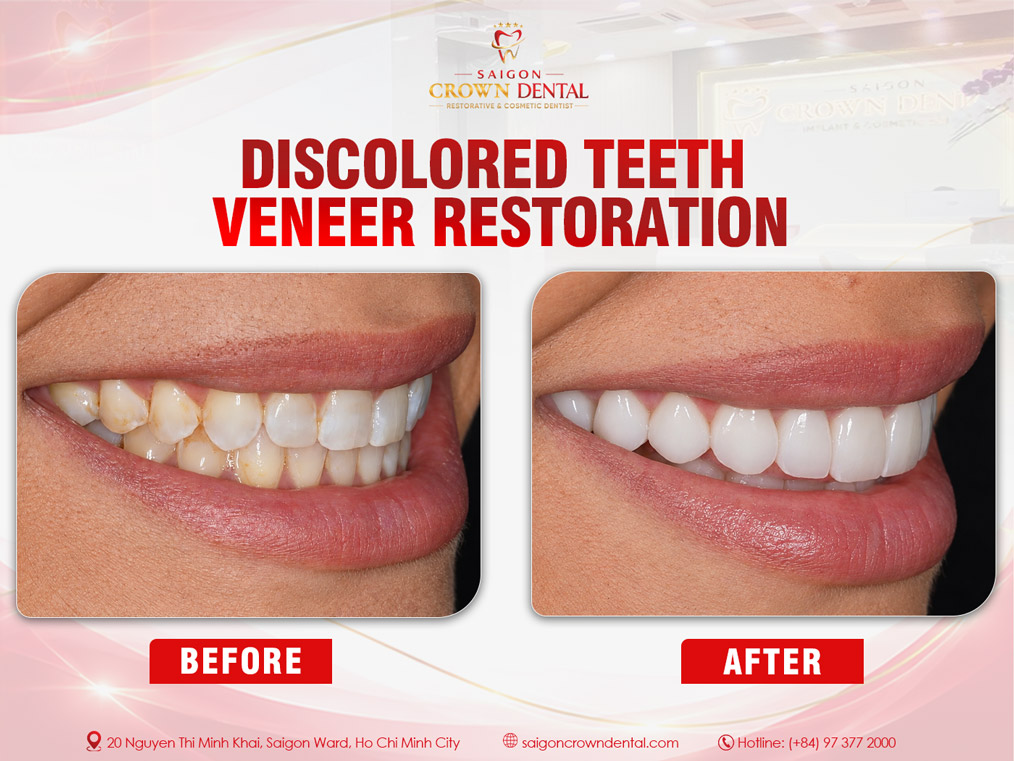
Case 4 – Yellow-Stained Teeth Veneer Restoration
Noticeable yellow-orange staining covered the front teeth, dulling the overall smile despite normal tooth alignment. Veneers delivered an even, brighter shade for a refreshed, natural-looking smile.
-
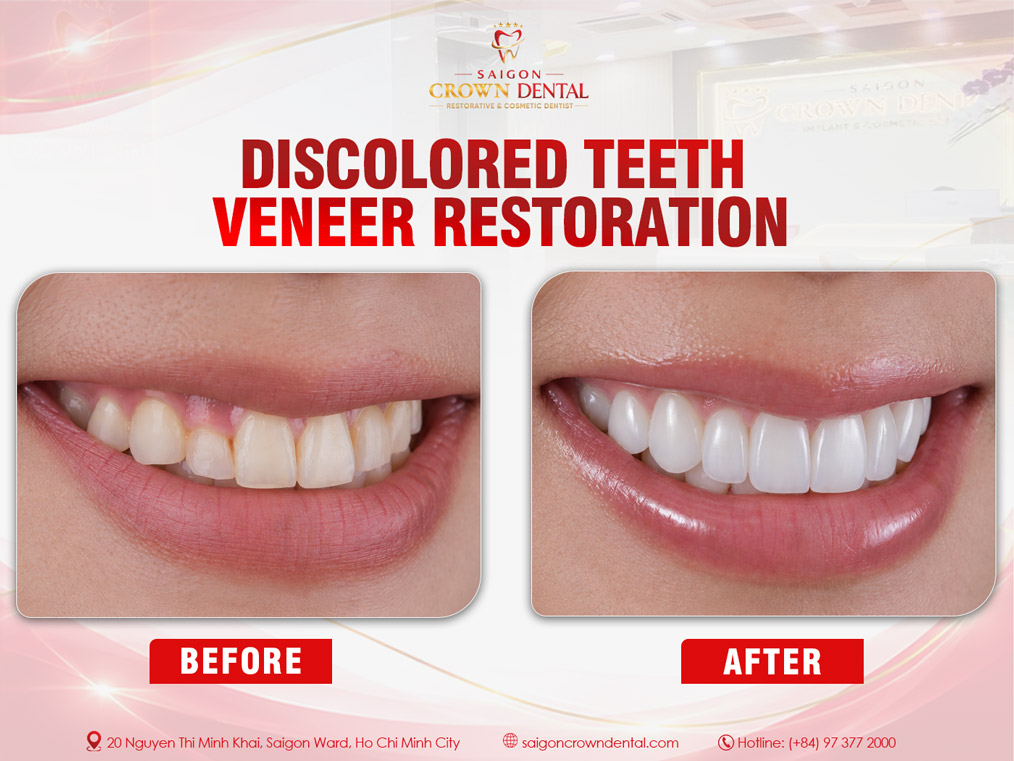
Case 5 — Heavily Discolored Teeth Veneer Restoration
Deep yellow staining along the gum line and uneven tooth edges gave the smile an aged, worn appearance. Veneers corrected the shade and edge shape together for a fuller, whiter result.
-
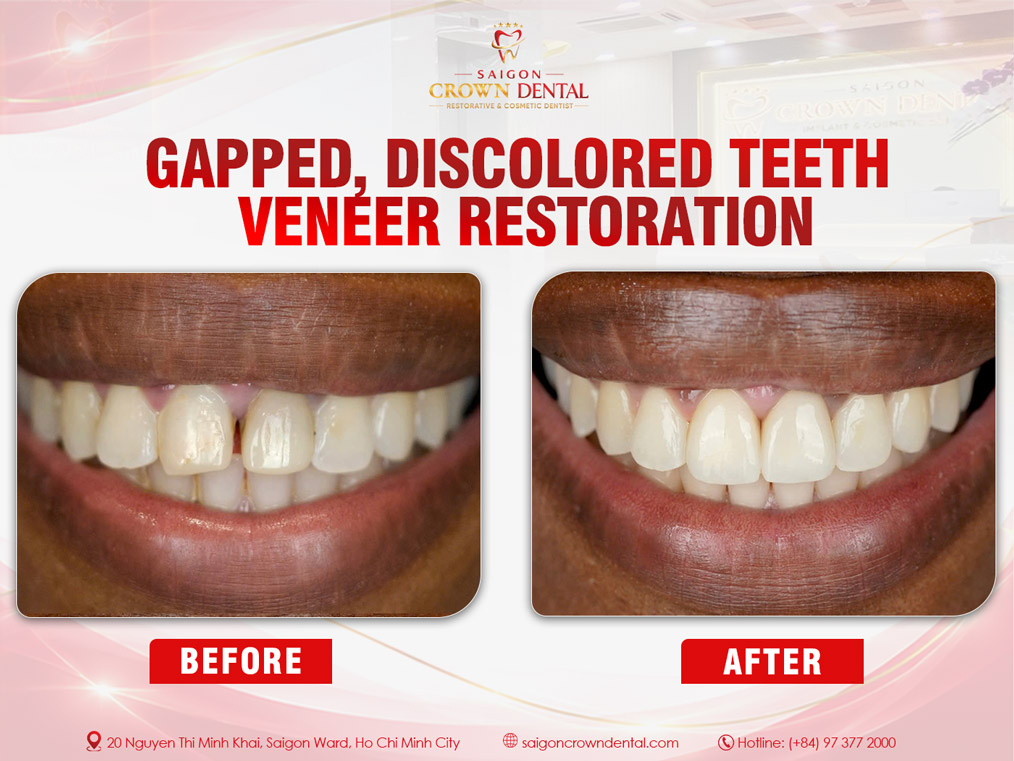
Case 6 – Gapped, discolored teeth veneer restoration
A visible gap between the front teeth combined with dull, yellowed enamel reduced smile confidence. Veneers closed the gap and brightened the shade in a single treatment.
-
Case 7 – Worn, gapped teeth veneer restoration
Worn tooth edges and a slight gap between the central teeth affected both bite comfort and appearance. Veneers restored the natural edge shape while closing the gap for a fuller smile.

-
Case 8 – Gapped, discolored teeth veneer restoration
A wider gap and yellow – brown staining across the front teeth created an uneven, aged appearance. Porcelain veneers closed the spacing and refreshed the color for a youthful result.

-
Case 9 – Chipped, misaligned teeth veneer restoration
Chipped edges and slightly misaligned front teeth disrupted the smile line. Veneers rebuilt the chipped areas and visually straightened the teeth without orthodontic treatment.

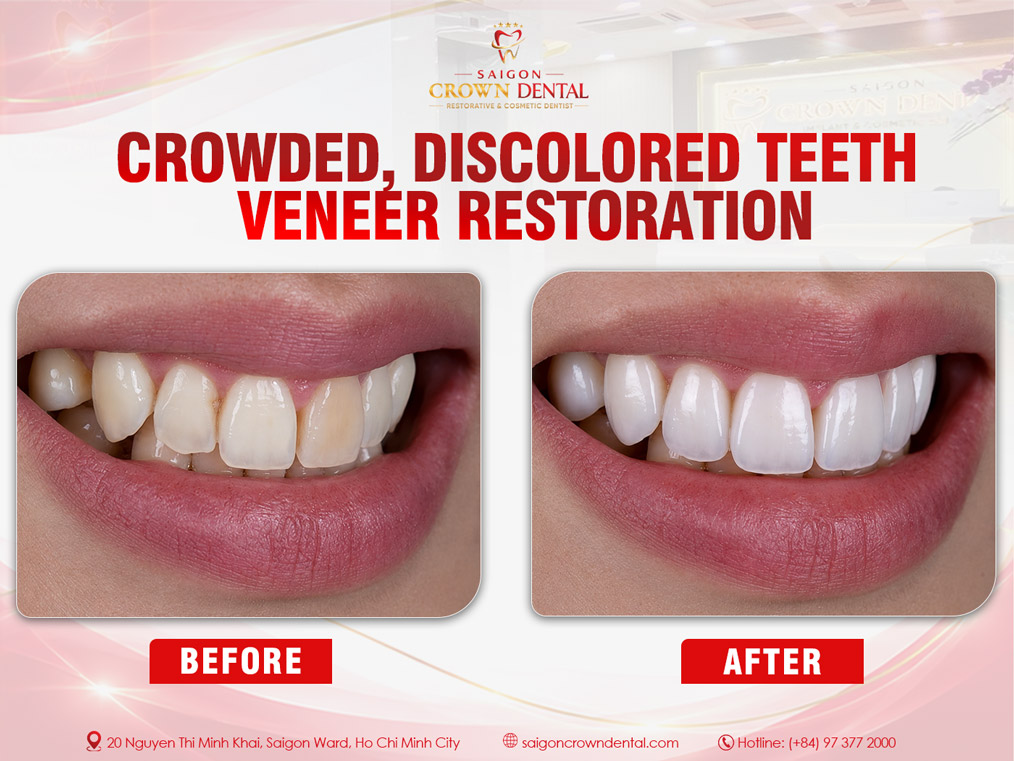
-
Case 10 – Crowded, discolored teeth veneer restoration
Overlapping, discolored teeth in the smile zone made the arrangement look uneven. Veneers corrected the visual alignment and unified the tooth shade.
-
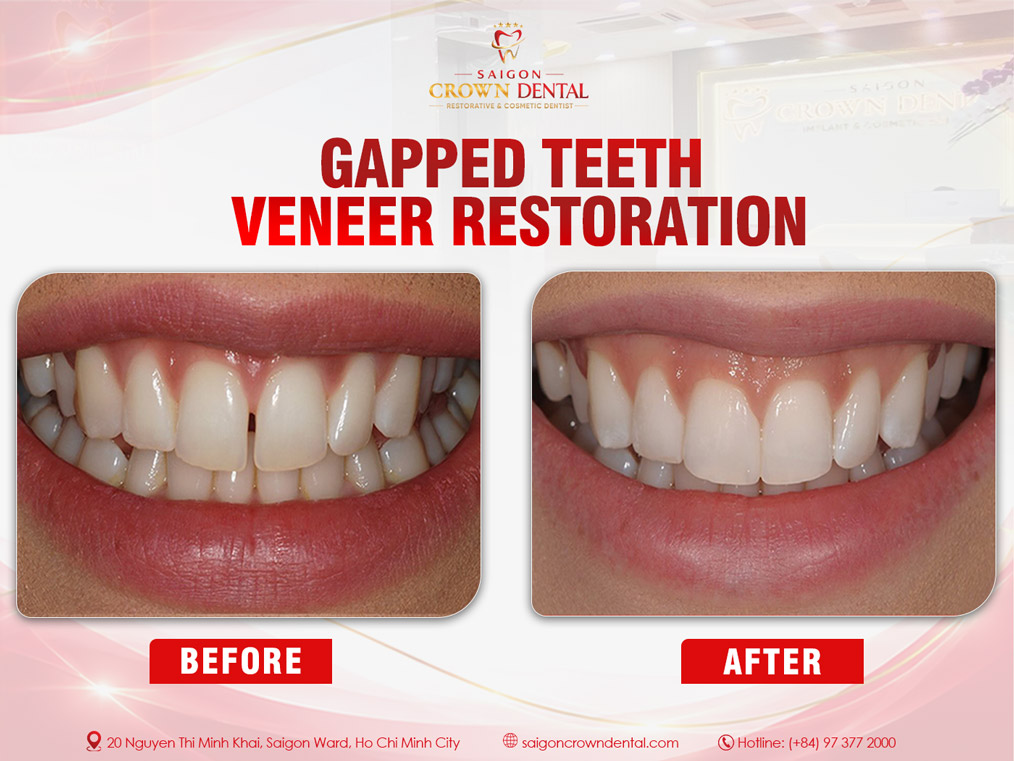
Case 11 – Gapped teeth veneer restoration
A single noticeable gap between the front teeth was the main concern, with otherwise healthy – looking teeth. Veneers closed the gap seamlessly for a naturally even smile.
How Much Do Porcelain Veneers Cost?
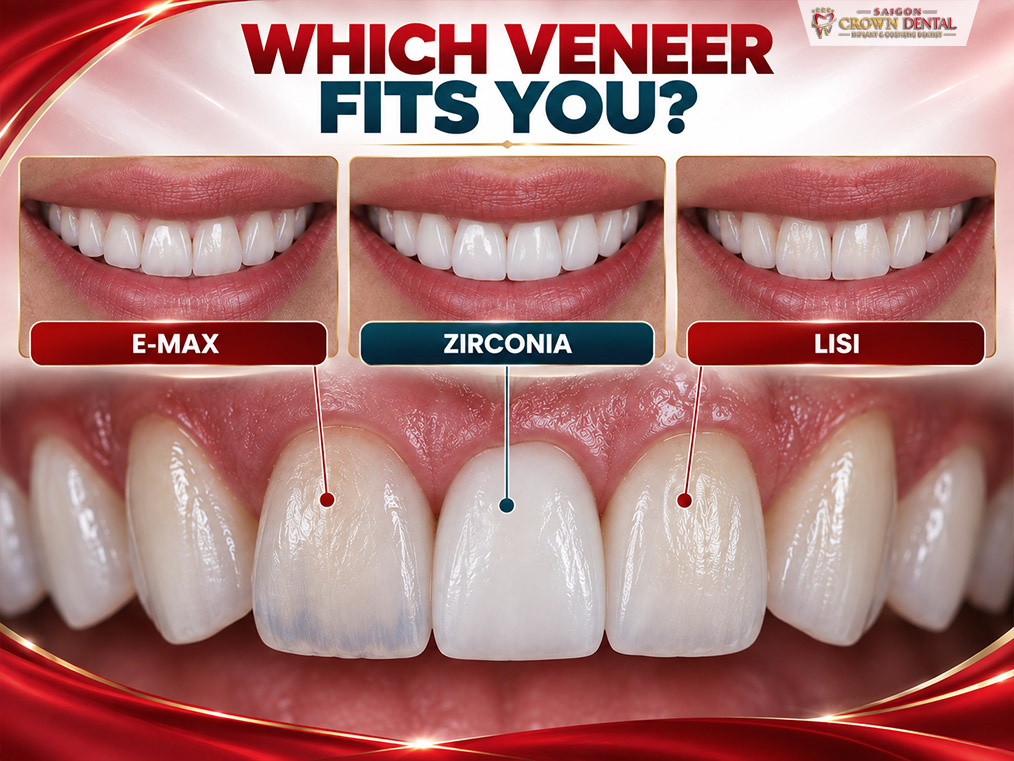
The cost of porcelain veneers depends on a few specific factors: the ceramic type (Feldspathic, E.max, or E.max Press), the number of teeth involved (typically 6–10 for a full smile makeover), and how complex the design work is.
| TREATMENT | PRICE IN USD | NOTE |
| Veneer E.max Zirconia | $320 | per tooth |
| Veneer E.max Press | $360 | per tooth |
| Veneer Lisi | $400 | per tooth |
| Inlay/Onlay E.max | $200 | per tooth |
Reference pricing only, before VAT. The final cost depends on your actual dental condition after an in-person exam.
International patient offer: patients getting 20 or more porcelain restorations (including veneers) receive a combo package worth up to $400, including a free consultation and exam, free X-rays, free Tan Son Nhat Airport pickup, a free first taxi transfer from your hotel to the clinic (within a 10km radius), 5 free nights at a premium hotel, and an additional 5% discount for groups of two or more.
Why Choose Saigon Crown Dental for Porcelain Veneers
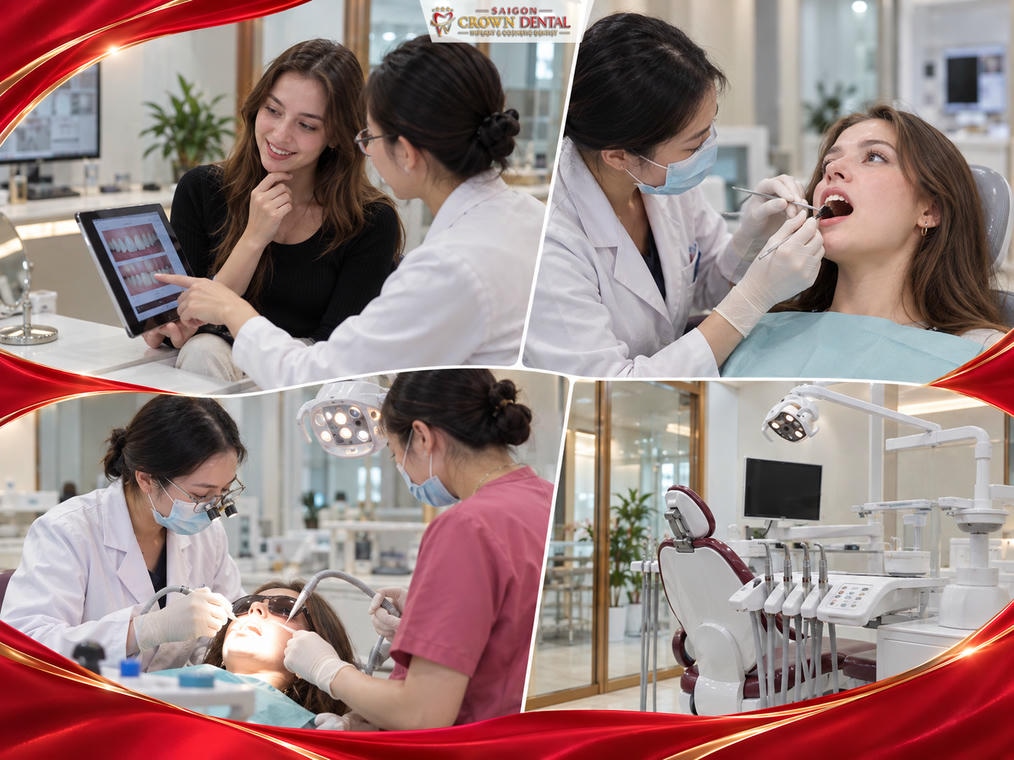
Our clinical team, led by Dr. Anh Van, combines strong general dentistry with specialized training in cosmetic dentistry and smile design. Consequently, we’re well set up to serve overseas Vietnamese and international patients.
-
Located in the heart of Ho Chi Minh City
Easy to reach for local patients, medical tourists, and the expat community.

-
English-speaking clinical team
Consultations and treatment plans are explained transparently, with no language barrier.
-
Deep specialization
Our core focus is Dental Crown & Restorative Dentistry, so veneer cases are planned with full restorative expertise, not as a side offering.
-
Modern CAD-CAM technology and 3D scanning
Precise veneer design with shorter turnaround times.

-
International safety standards
Sterilization protocols meet AAMI, Vietnam’s Ministry of Health, and FDA guidelines.
Digital Smile Design (DSD)
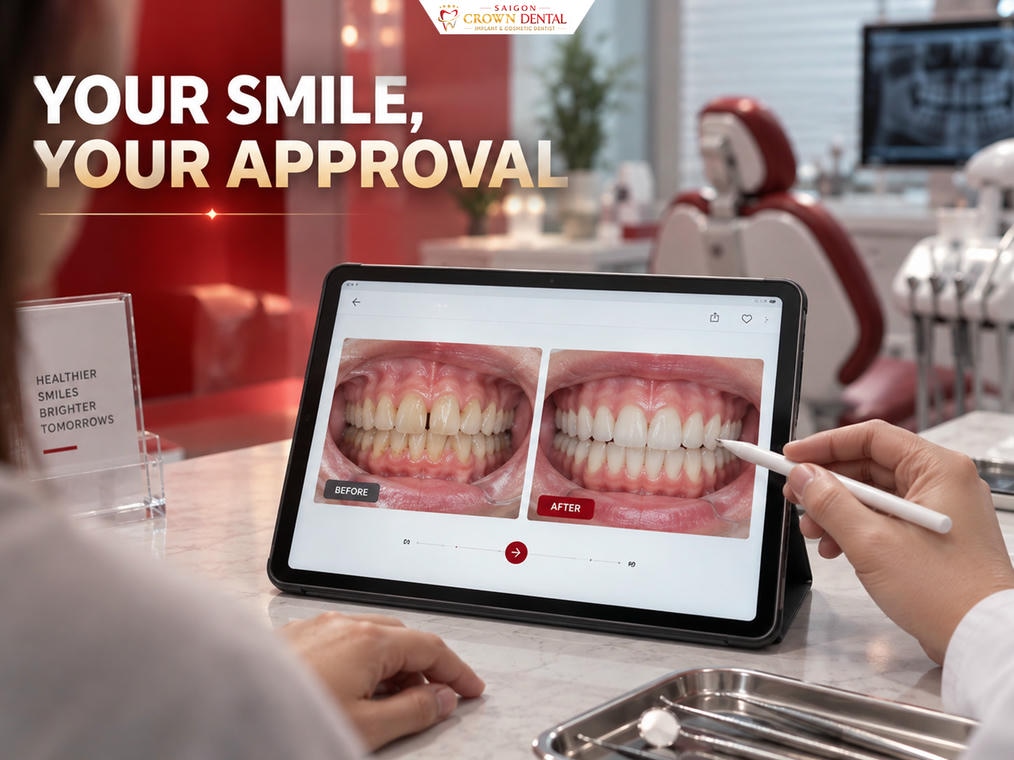
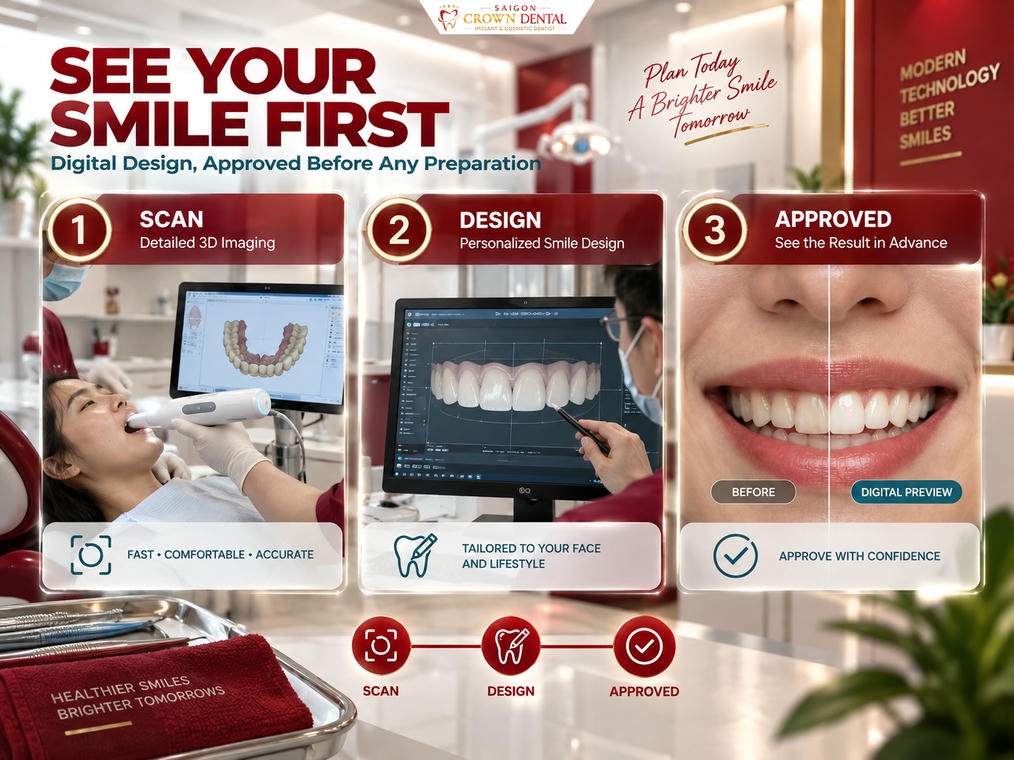
Before a single layer of enamel is touched, you’ll preview the final result on your own face. This step is a required part of our process, not an optional add-on.
- Your face and current smile are photographed and 3D-scanned.
- The dentist uses digital smile design software to simulate the shape, proportion, and shade of your veneers, matched to your facial structure, skin tone, and age.
- You review and approve a mock-up – a temporary trial version tested directly in your mouth – before any reduction happens.
Because tooth reduction can’t be undone, this is the most important reassurance step in the entire process. You deserve to know exactly what you’re getting before treatment starts.
Support for International Patients and Expats
-
Accommodation and transport support
Help finding lodging, arranging transport, and building a treatment schedule around your time in Vietnam.
-
Flexible payment options
Cash, bank transfer, or card payment.
-
Clear material warranty
Transparent warranty terms give you peace of mind even after returning home.
-
Fast turnaround
Most cases finish in 5-7 days, with temporary veneers ready in as little as 48 hours.
Frequently Asked Questions About Porcelain Veneers
-
Can veneers accidentally turn into crowns?
No. At Saigon Crown Dental, we only carry out the exact veneer plan agreed with you – we never expand the reduction to convert to a crown without your consent.
-
Why can veneers be so thin and still hold up?
Depth-guide grooves keep the reduction precisely within 0.3–0.7mm, and the Lithium Disilicate ceramic bonds chemically to the remaining enamel. Once that bond sets, the two layers behave almost as one structure, reaching a material strength of 400–450 MPa.
-
Do porcelain veneers hurt?
Your dentist applies local anesthesia before any reduction, so the procedure itself is essentially painless. You may feel mild sensitivity for the first few days while wearing your temporary veneers.
-
How long do porcelain veneers last?
On average, 10–15 years or longer with proper care – avoiding biting hard objects and keeping up with scheduled check-ups.
-
Can I see the result before treatment starts?
Yes. The Digital Smile Design process lets you review and approve a mock-up on your own face before any reduction – this step is mandatory in our process, not optional.
-
How many appointments will I need?
Typically two main visits: one for design, reduction, and impressions, and a second to bond your final veneers once the lab has finished fabrication.
Book Your Consultation Today
Thinking about improving your smile but still unsure how much reduction is involved, or whether veneers are right for your teeth? Leave your details, and our team at Saigon Crown Dental will reach out for a free consultation and schedule a visit that works for you.
Porcelain veneers are a proactive cosmetic solution – a natural, harmonious smile without sacrificing your real tooth structure. Located in the heart of Ho Chi Minh City, with an English-speaking team led by Dr. Anh Van, Saigon Crown Dental is with you from your first consultation to the smile you were shown from the very start – exactly as promised, with no surprises.