
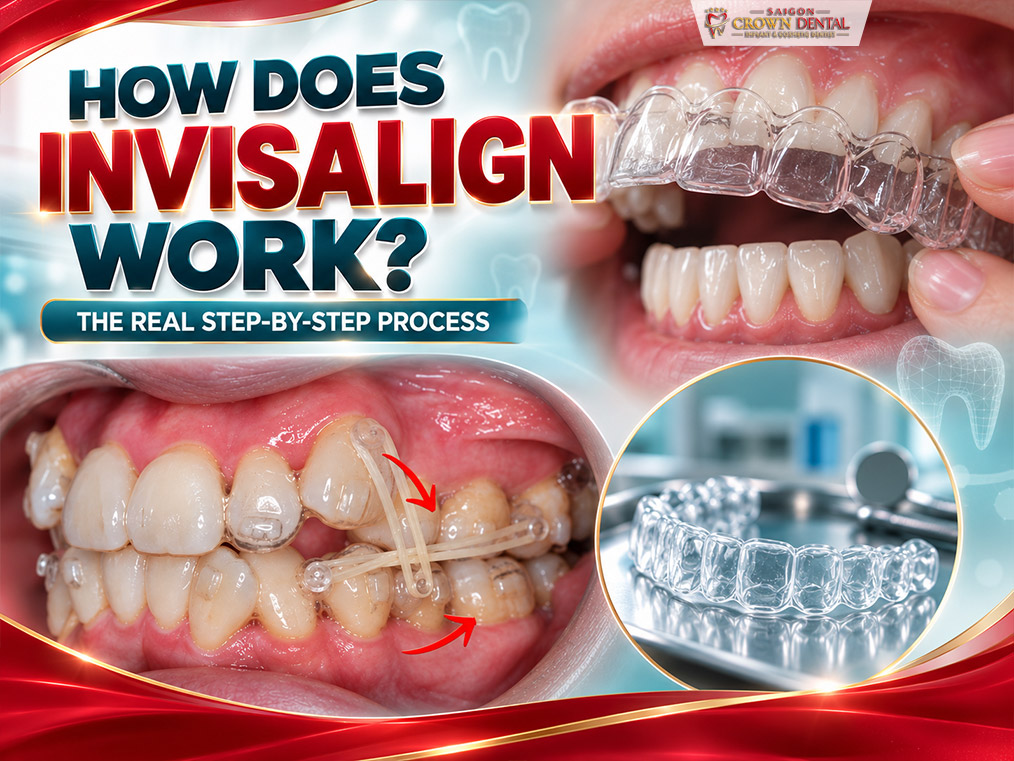
So, how does Invisalign work? It uses a series of custom SmartTrack® clear trays to shift your teeth, one small step at a time. No brackets. No wires. Just a quiet digital plan, carried out tray by tray. Here is exactly how that happens – and what to expect along the way.
The Full Process, Explained Simply
Most patients picture Invisalign as one long, vague treatment. In reality, it is a tight sequence of predictable steps, and each one builds directly on the last.
It starts with data, not guesswork. Your dentist scans your teeth in 3D, then ClinCheck software maps every planned tooth movement before a single tray is made – so you preview your future smile before treatment even begins.
From there, a full tray series is manufactured for your bite. Trays are milled from SmartTrack, a multilayer medical-grade thermoplastic that hugs the tooth surface closely, applying gentle, continuous pressure rather than the harsher pull of a metal wire.
Here is how does Invisalign work at Saigon Crown Dental, step by step:
-
3D digital scan
Replaces messy putty impressions with a fast intraoral scan.
-
ClinCheck plan and approval
You preview your full journey before committing.
-
Custom aligners are made
A full series is produced for your approved plan.
-
Daily wear, 20-22 hours
Trays come out only to eat, drink, and clean teeth.
-
Tray switch every 1-2 weeks
Based on how your teeth respond.
-
Check-ins every 6-8 weeks
In person locally, or combined with remote monitoring if you live abroad.
-
Retainer phase
Locks in your result once treatment finishes.
That sequence rarely changes. What changes is how long each patient spends inside it.
[HÌNH ẢNH: Sơ đồ quy trình điều trị Invisalign tại Saigon Crown Dental | Size: 1014×760 | Alt text: invisalign treatment process steps saigon crown dental | Title: invisalign-treatment-process-steps]
How Does Invisalign Move Your Teeth?
Knowing the steps is one thing. Understanding how does Invisalign move your teeth is the question most patients actually care about.
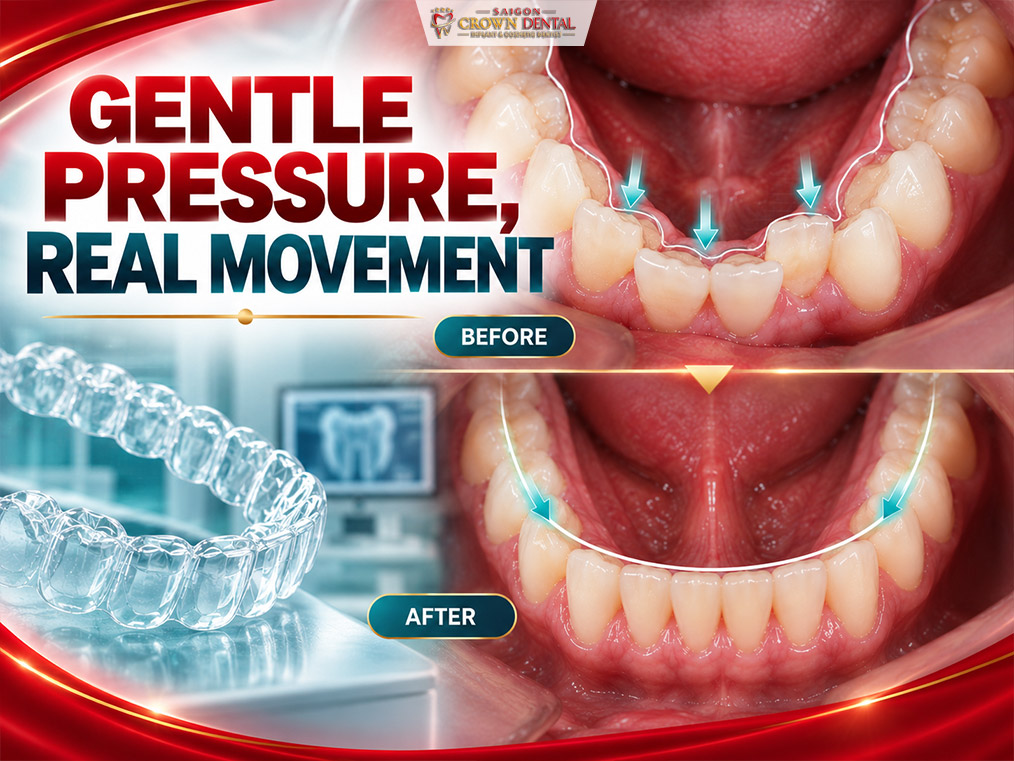
The short answer is pressure, applied precisely. Each tray is shaped a fraction differently from your current tooth position. That mismatch creates gentle, constant force the moment you put it in.
Smooth enamel alone does not give the tray enough grip for complex movements. For rotating a tooth, or pulling one up or down, your dentist bonds small tooth-colored attachments onto specific teeth so the tray has an anchor point to steer against.
Behind the scenes, ClinCheck breaks your journey into micro-stages. At every check-in, your dentist compares your actual progress against the simulation. If a tooth drifts off-path – called Off-Tracking – the plan gets refined or wear time extended before it becomes a bigger issue.
Each tray shifts teeth by a small, controlled amount before its effect plateaus.
Attachments guide rotation and tilt that flat plastic alone cannot control.
A foam “chewie,” bitten for 5-10 minutes daily, helps seat the tray fully.
How Long Does Invisalign Take to Work?
This is usually the next question, right after how does Invisalign work – and fairly so.
At Saigon Crown Dental, most adult cases run 12 to 18 months, depending on how much correction is needed. Mild cases in the Invisalign Lite range typically move faster, since fewer trays are required. Moderate to complex cases under Invisalign Full take longer, simply because there is more distance for teeth to travel safely.
There is no single number that fits every patient. Your dentist confirms your personal timeline after reviewing your 3D scan, so the estimate you receive is never generic.

Invisalign vs Traditional Braces: How It Works Differently
Once patients understand how Invisalign works on its own, the comparison to traditional braces comes up almost automatically.
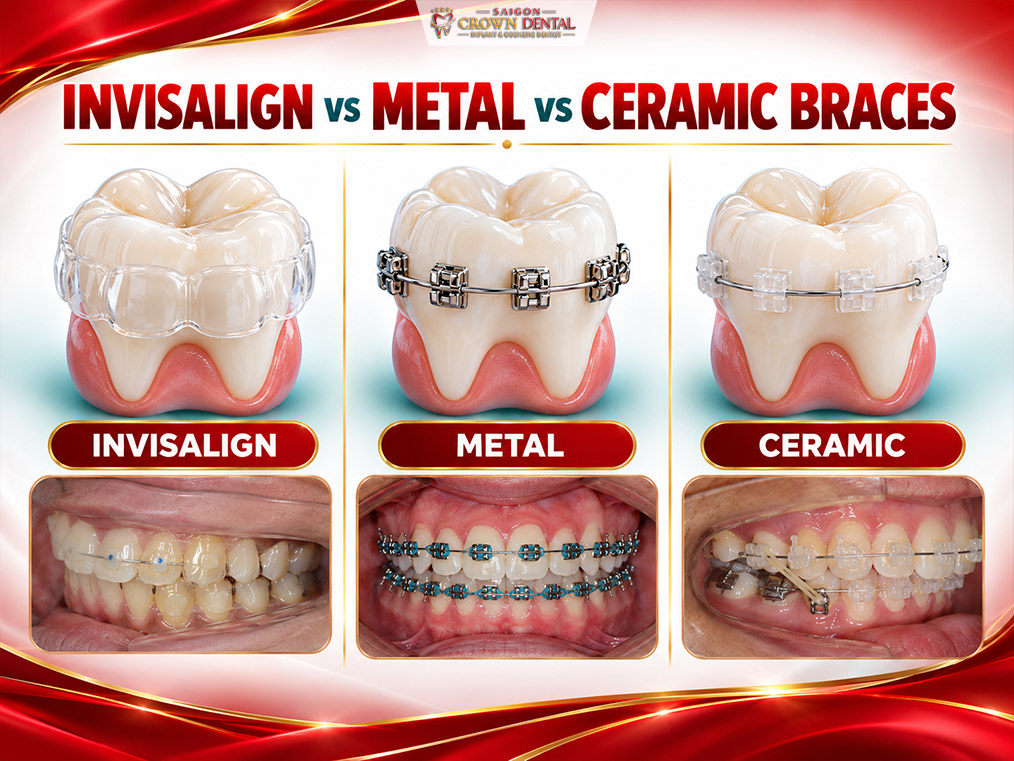
Both rely on the same idea – controlled pressure moves teeth over time. Braces apply that pressure through a fixed wire, tightened manually at each visit. Invisalign pre-programs every adjustment into the tray sequence itself, so no in-office tightening is needed.
That difference matters most for international patients, since it changes how often you actually need to be in the clinic.
|
Criteria |
Metal Braces |
Ceramic Braces |
Invisalign Aligners |
|
Visibility |
Highly visible |
Less visible |
Nearly invisible |
|
Removable |
No |
No |
Yes, for eating and brushing |
|
Average treatment time |
18-24 months |
18-24 months |
12-18 months (case-dependent) |
|
Clinic visit frequency |
Every 2-4 weeks |
Every 2-4 weeks |
Every 6-8 weeks, with remote monitoring |
|
Suited to overseas patients |
Hard to monitor remotely |
Hard to monitor remotely |
Best suited |
For patients splitting treatment across trips to Vietnam, that lower visit frequency is often the deciding factor – not just the appearance.
Is Invisalign Discomfort Normal? What to Expect
By this point, most patients understand how does Invisalign work in theory. What worries them next is more physical – will it actually hurt?
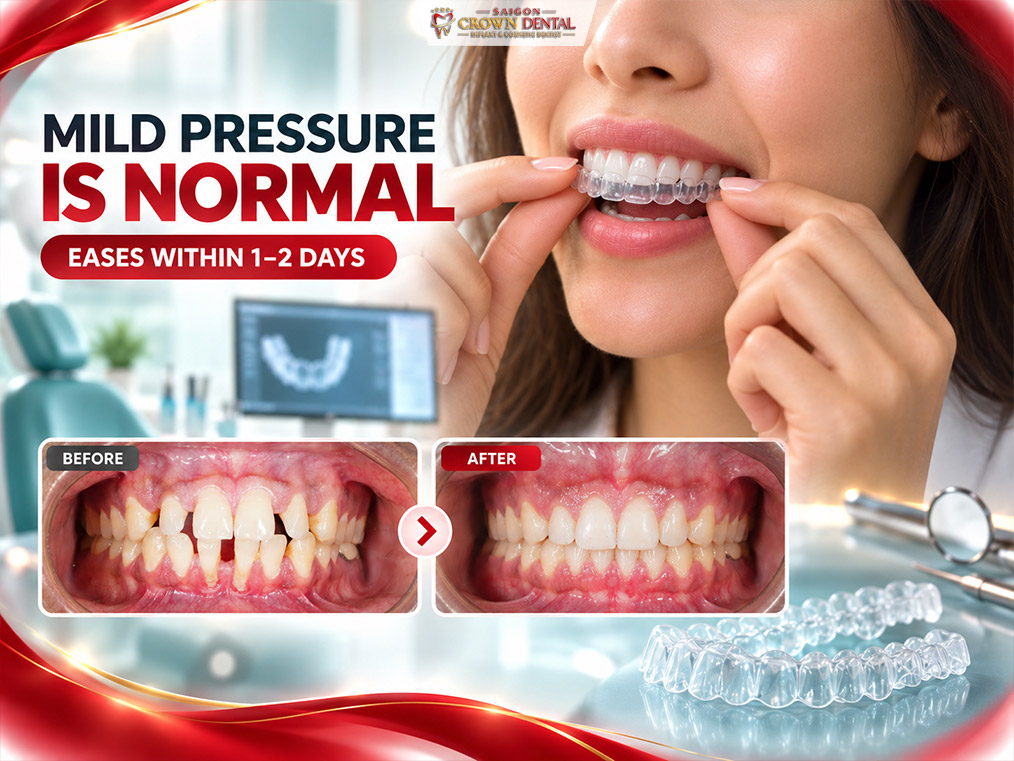
Mild pressure is expected, and it is a good sign the tray is working. Invisalign discomfort typically shows up in the first 1-2 days after switching to a new tray, then fades on its own as your teeth adjust.
This should feel like tightness, not sharp pain. If a tray edge rubs against your gums, dental wax usually solves it fast.
Mild pressure for 1-2 days after each tray switch is normal.
Discomfort is generally lighter than tightening metal braces.
Light gum rubbing can be smoothed with dental wax.
Sharp or lasting pain is not typical and should be checked by your dentist.
Who Is a Good Candidate for Invisalign?
Understanding how does Invisalign work naturally leads to one last question: is it right for you?
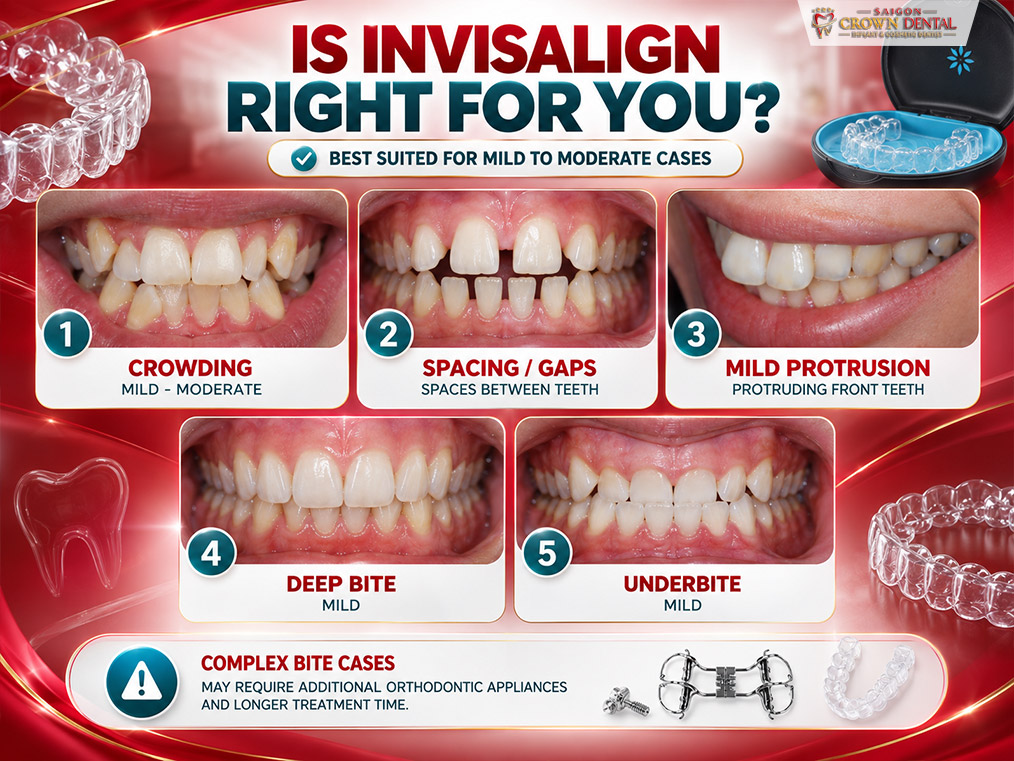
Invisalign works best for mild to moderate crowding, gaps between teeth, or a mild bite misalignment. More complex cases can still be treated, but usually need additional appliances – something your dentist confirms only after an in-person exam and 3D scan.
In practice, a few groups benefit the most:
-
Working professionals
Who want a discreet option for client meetings and presentations.
-
Expats and international patients
Who need a schedule built around trips home, not a fixed weekly visit.
-
Students and young adults
Who want to eat and clean their teeth without navigating brackets.
-
Anyone hesitant about traditional braces
Looking for a gentler day-to-day experience.
Invisalign Pricing at Saigon Crown Dental
Cost is one of the first practical questions once patients understand the process. At our clinic, pricing is published upfront, with every aligner, check-up, and retainer included.
|
Treatment Level |
Best For |
Reference Price (USD) |
|
Invisalign Lite |
Mild misalignment, fewer aligners needed |
$1,800 – $2,500 |
|
Invisalign Full |
Moderate to complex misalignment |
$2,800 – $4,200 |
|
Invisalign Full + International Support |
Long-distance patients needing remote monitoring |
$3,200 – $4,500 |
Reference pricing only, before VAT. Final cost depends on your actual dental condition after an in-person exam.
Remote Monitoring: Staying on Track After You Fly Home
For international patients and Vietnamese expats, the real concern is rarely the price – it is who is watching your progress once you have left the country.
Before you leave Vietnam, your dentist prepares a full set of aligners for your next stage, along with a week-by-week wearing schedule. You then send progress photos or hop on a video call so your dentist can check tracking and catch any issues early.
If an adjustment is needed, the clinic coordinates with a local dentist if you have one, or plans your next visit to Vietnam around it – so nothing is left to guesswork between appointments.
Source: American Association of Orthodontists – clinical guidelines on clear aligner therapy
Knowing how does Invisalign work is only half the picture. The other half is knowing whether it fits your bite, your timeline, and the life you actually live between visits to Vietnam.
At Saigon Crown Dental, that conversation starts with a full 3D scan, not a sales pitch. Dr. Anh Van reviews your bite personally and explains exactly what to expect – month by month, in plain English.
Located in central Ho Chi Minh City, the clinic is easy to reach for local patients, visiting family, and the expat community. Every plan comes with published pricing and a remote monitoring schedule mapped out before you ever fly home.
If you are still weighing whether Invisalign fits your smile, a free consultation is the simplest way to find out.