
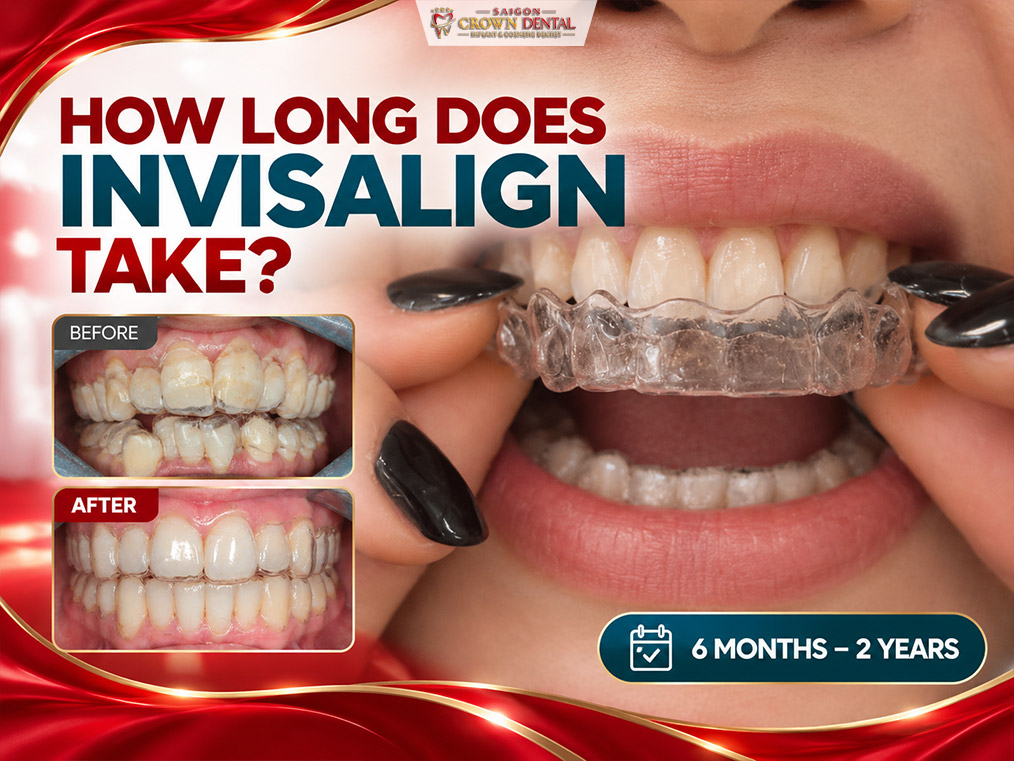
Achieving a straight, confident smile is a goal many people carry for years. Orthodontic treatment is a bigger commitment than a single cosmetic visit. It asks you to plan your schedule around safety and long-term results. So the question most patients ask first is simple: how long does Invisalign take? Getting a clear answer matters most for expats, international patients, and anyone juggling a demanding schedule. Knowing the timeline upfront makes it far easier to plan around work, travel, and visa dates. This guide breaks down exactly what shapes that timeline, so you can picture your own journey with confidence.
How long does Invisalign take on average?
At Saigon Crown Dental, most Invisalign cases take 12 to 18 months, depending on how much correction is needed. That’s already faster than traditional braces, which typically run 18 to 24 months from start to finish. However, the timeframe still reflects the biological pace at which tooth roots can safely shift within the jawbone. As a result, it isn’t a number that can be rushed without risking the outcome.
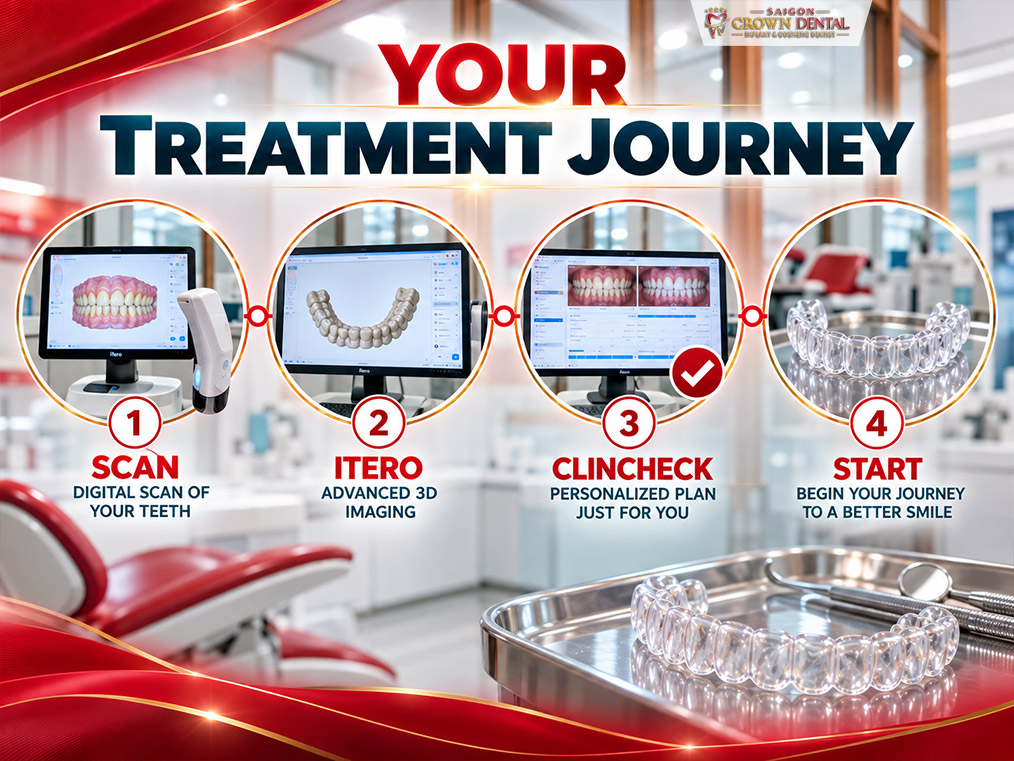
Before any aligners are made, your dentist takes a 3D digital scan to map your bite and jaw structure in full. That scan feeds into ClinCheck simulation software. So you can preview how your teeth are expected to move at each stage, well before committing to the plan – a level of visibility traditional braces simply can’t offer upfront.
Treatment length generally tracks with the clinic’s own case levels:
-
Invisalign lite (mild misalignment):
Fewer aligners, so treatment tends to finish toward the faster end of the range.
-
Invisalign full (moderate to complex misalignment):
The standard 12 to 18-month path most patients follow.
-
Complex or heavily crowded cases:
Can extend to 24 months, in line with more involved cases generally.
Each aligner is worn for roughly 1 to 2 weeks before switching to the next. Specifically, this depends on the treatment stage, aligner type, and how well your teeth are tracking. Check-up frequency isn’t fixed either. It depends on how many aligners your dentist hands you at each visit, which is generally less often than with traditional braces. Once the main movement phase ends, many patients transition to a retainer to keep their results stable long-term.
Factors that affect Invisalign duration
No two patients finish at exactly the same pace. Several biological and behavioral factors influence the real-world timeline. Understanding these variables in advance helps you set realistic expectations, rather than fixating on a single average number.
Specifically, your dentist assesses each of these conditions closely before building a plan tailored to you. In practice, how well your daily habits match your dentist’s instructions plays just as large a role as your starting bite.
-
Severity of misalignment:
Minor spacing or crowding resolves faster than a significant bite misalignment.
-
Wear-time compliance:
Aligners need 20 to 22 hours of daily wear to keep steady pressure on your teeth.
-
Biological response:
How quickly your jawbone and surrounding tissue adapt varies by age and individual body.
-
Aligner-change schedule:
Sticking closely to your switch schedule keeps movement on track and prevents stalls.

Why compliance matters most
Of all these factors, wear time is the one entirely within your control. Taking aligners out too often, during meals, meetings, or simply forgetting to put them back in, is the single biggest cause of delays. Setting phone reminders or building the habit around mealtimes is usually enough to keep treatment on schedule.
Which cases work best with Invisalign
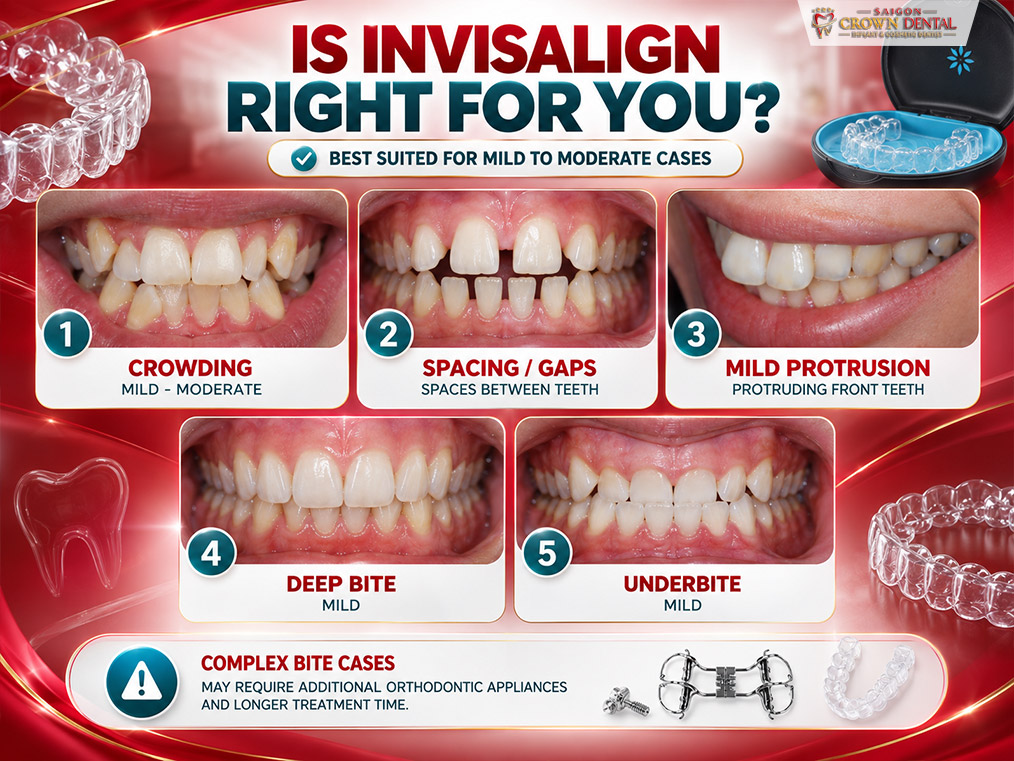
However, not every case is equally time-efficient with Invisalign. It tends to work best for:
-
Mild to moderate crowding or crooked teeth.
-
Gaps or spacing between teeth.
-
Mild protruding or flared front teeth.
-
Mild deep bite or crossbite.
For more complex bite issues, your dentist may add auxiliary attachments to the treatment. This can also extend the overall timeline.
Invisalign vs Braces Treatment Time
Comparing timelines across treatment options is usually top of mind before patients commit to a method. That’s because the right choice often comes down to lifestyle just as much as clinical need. Weighing the pros and cons side by side makes it much easier to land on the best fit.
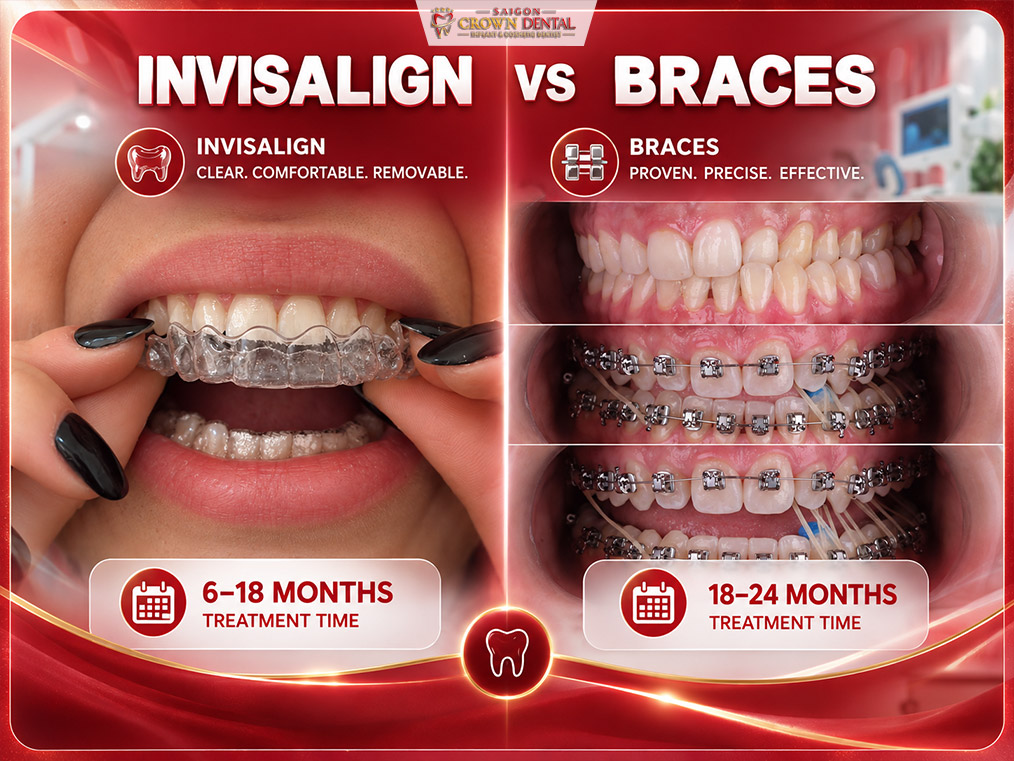
Dental professionals generally agree that Invisalign has a clear speed advantage for mild-to-moderate cases. Traditional braces, meanwhile, remain the standard choice for more structurally complex bites. That trade-off is worth factoring in alongside your professional schedule and aesthetic priorities.
|
Criteria |
Invisalign |
Traditional Metal Braces |
Self-Ligating Braces |
Ceramic Braces |
|
Average duration |
12–18 months (case-dependent) |
18–24 months |
18–24 months |
18–24 months |
|
Check-up frequency |
Every 6–8 weeks |
Every 3–4 weeks |
Every 4–6 weeks |
Every 3–4 weeks |
|
Aesthetics |
Nearly invisible |
Most visible |
Moderate to low visibility |
Good, tooth-colored |
|
Self-discipline required |
High (20–22 hrs/day) |
None, fixed appliance |
None |
None |
|
Comfort |
Highest, smooth plastic |
Lower, can irritate |
Moderate |
Moderate |
|
Best suited for |
Mild to moderate cases |
Mild to severe cases |
Mild to severe cases |
Mild to severe cases |
Data compiled from Align Technology and the American Association of Orthodontists, alongside internal clinical data from Saigon Crown Dental.
Digital scanning also shortens the planning phase considerably. An intraoral 3D scan takes just a few minutes, with no gag-inducing impression tray involved. Data is sent instantly for review, rather than waiting on a physical mold, and any errors are flagged immediately within the software instead of showing up later. As a result, the early planning stage of Invisalign is typically much faster than treatments relying on traditional impressions.

See also: https://saigoncrowndental.com/invisalign-near-me-trusted-clinic-in-vietnam-for-expats-locals/
How many aligners do you need for Invisalign
The total number of aligners used across your treatment really drives the overall timeline, more so than the month count alone. That total depends entirely on how far each tooth needs to travel to reach its final position.
Most patients want a concrete number before they commit. On average, therefore, a full case uses 20 to 30 aligners, while more complex cases can require over 40.
Each aligner is worn for roughly 1 to 2 weeks before moving to the next, depending on the treatment stage and how your teeth are tracking. That’s why the total aligner count, not the month count alone, is the real driver of your actual treatment time.
- Mild cases: roughly 10–20 aligners.
- Moderate cases: roughly 20–30 aligners.
- Severe or complex cases: 30–50+ aligners, sometimes with extra refinement trays.

Invisalign for teens vs adults duration
Age is one of the biggest questions parents and adult patients bring to their first consultation. Teeth at different life stages, after all, respond to pressure somewhat differently. Naturally, that raises questions about whether age changes the timeline.
That said, adults complete treatment successfully every day. In fact, the real deciding factor remains wear-time compliance, not age itself.
-
Invisalign for Teens.
Teen aligners include a built-in compliance indicator: small blue dots that fade as the aligner is worn for enough hours each day. This helps your dentist confirm proper wear at each check-up. Treatment generally takes 12 to 18 months, similar to adults with a comparable case.
-
Invisalign for Adults.
Adults sometimes already have crowns or missing teeth, which can add extra planning time upfront. Even so, most healthy adults finish within 6 to 18 months, matching outcomes seen in teens with the same level of compliance.
Real clinic treatment journey
Many patients feel uncertain simply because they don’t know what to expect before their aligners arrive. Fortunately, the process is broken into clearly defined stages, which makes the waiting period much easier to estimate.
At Saigon Crown Dental, a typical Invisalign journey follows five stages:
-
Consultation and 3D digital scan:
A general exam, X-rays, and a full scan of your upper and lower arches.
-
ClinCheck simulation and plan approval:
You preview your entire projected journey before committing to anything.
-
Receiving your aligners in stages:
Trays arrive in batches, switched roughly every 1–2 weeks.
- Ongoing check-ins or remote monitoring:
Local patients return every 6–8 weeks in person, while patients based abroad combine occasional visits with remote monitoring in between.
-
Wearing your retainer:
Once teeth reach their final position, a retainer keeps the result stable long-term.
Most Invisalign Full cases need only 3 to 5 in-person visits in total, mapped out at your very first consultation so there are no surprises mid-treatment.
Tips to stay on track
If you’re an expat or international patient based in Vietnam, travel can, at times, make it harder to keep every check-up. Fortunately, a few simple habits go a long way toward keeping treatment on schedule, even with a busy calendar.
- Wear your aligners 20–22 hours a day, removing them only to eat and brush.
- Send progress photos or hop on a video call through Email or WhatsApp between visits, so your dentist can catch any off-track movement early.
- Book in-person check-ups around your travel dates rather than skipping them, even around business trips.
- Carry a backup aligner set when traveling for extended periods.
Consequently, remote monitoring is what lets most international patients get by on just 3 to 5 in-person visits for a full case, instead of flying back every few weeks.
Get a personalized Invisalign timeline
There’s no single answer to how long does Invisalign take that applies to everyone. Your actual timeline always comes down to your jaw structure and the degree of correction needed. That’s exactly why an in-person consultation with a specialist is the most reliable first step, before you commit to a plan.
Saigon Crown Dental sits in the heart of District 1, Ho Chi Minh City, making it easy to reach for local patients, dental tourists, and the expat community alike. Your Invisalign plan is reviewed by a dentist with 15+ years of orthodontic experience and an Invisalign Certified Provider credential, and the team consults confidently in English throughout. With 1,000+ successful cases and remote monitoring built into every international treatment plan, you stay covered even between visits, at a fraction of typical US, UK, or Australian pricing.
Book a free consultation today to get your own Invisalign roadmap, built around your travel schedule and personal timeline.