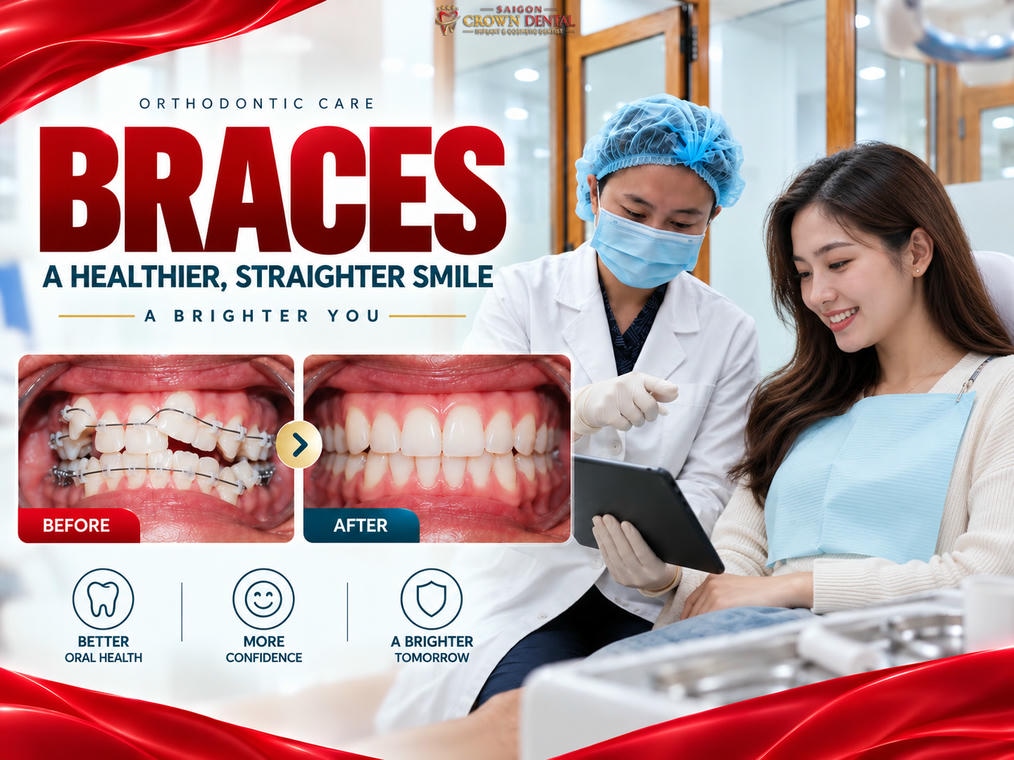
Researching Braces but not sure what it actually costs? Many patients worry the price will creep up mid-treatment. At Saigon Crown Dental, braces come with a published price list from your very first consultation. An experienced dentist assesses your teeth and recommends the right approach for your case, in line with our broader philosophy of preserving as much of your natural tooth structure as possible. This guide walks through what braces are, the process, the cost, and how to choose the right method.
What are Braces?
Braces use dental appliances to gradually move teeth into their correct position. The appliance can be traditional brackets or clear aligner trays. This process corrects protruding, overcrowded, or gapped teeth. As a result, your bite and chewing function improve alongside the appearance of your smile.
Many people think of braces purely as cosmetic treatment. However, a misaligned bite left untreated can put strain on the jaw joint over time. That’s why a full examination always comes before any method is recommended.
Braces are also, at their core, a tooth-preserving treatment. Unlike options that reshape or cover the tooth surface, braces work with the teeth you already have – repositioning them rather than altering or removing any natural tooth structure. That approach reflects Saigon Crown Dental’s broader philosophy: treat what’s genuinely needed, and preserve as much natural tooth as possible while doing it.
Braces vs. Cosmetic veneers
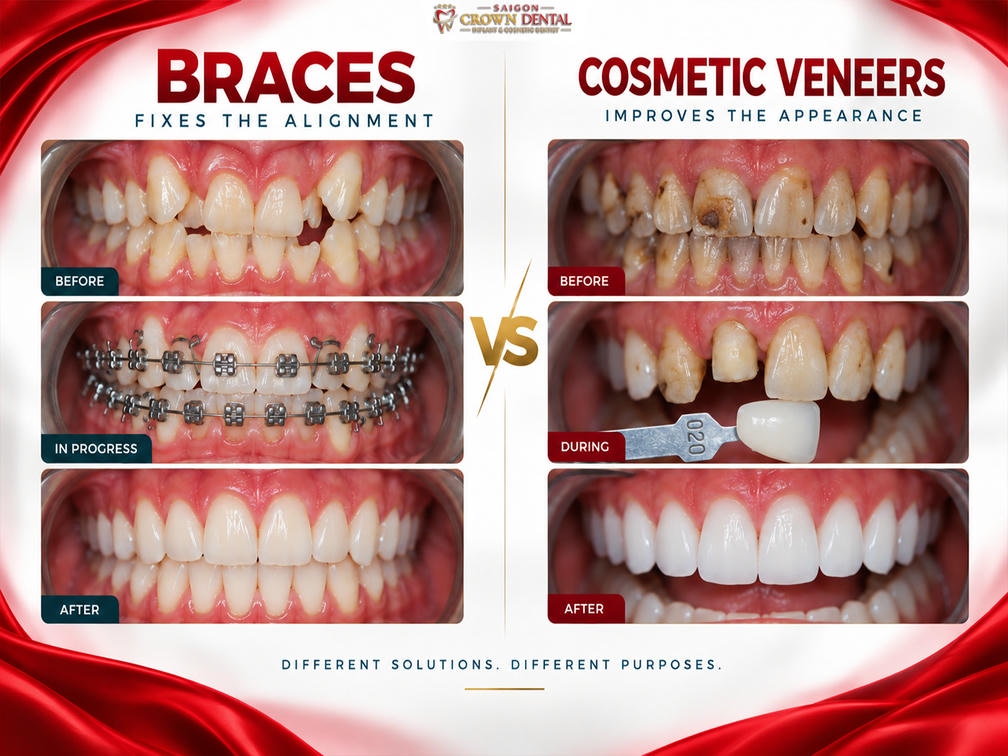
Some patients weigh braces against veneers when considering how to fix crooked teeth. These are fundamentally different solutions, and one doesn’t substitute for the other – the difference comes down to whether the tooth is preserved or altered.
Veneers only cover the front surface of a tooth, making it look straighter cosmetically. To fit them properly, a thin layer of natural enamel usually needs to be shaved down first – a step that’s permanent and can’t be undone. Veneers also don’t move the tooth and don’t correct an underlying bite problem.
Braces, on the other hand, work directly on tooth position within the jawbone – addressing misalignment and bite issues at the source, without touching or removing any natural enamel. For patients who want straighter teeth without giving up healthy tooth structure, that’s a meaningful distinction, not just a technical one.
Types of Braces
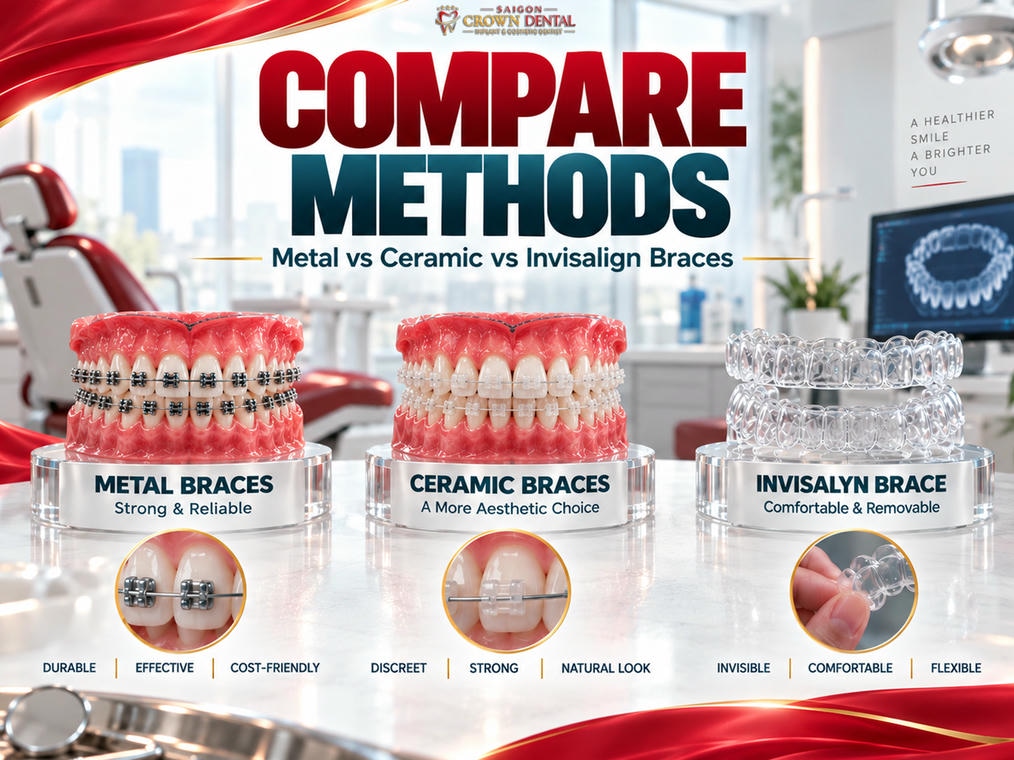
Three types of braces are commonly used today, and each suits a different need. Understanding the differences upfront makes the decision easier.
Metal braces are the most affordable option but are the most visible when you smile. Clear aligners are nearly invisible but cost more. The table below breaks down the differences.
|
Criteria |
Metal Braces |
Ceramic Braces |
Invisalign Aligners |
|
Cost |
Lowest |
Mid-range |
Highest |
|
Visibility |
Noticeable |
Less noticeable |
Nearly invisible |
|
Treatment time |
18-24 months |
18-24 months |
12-24 months |
|
Eating |
Avoid hard, sticky food |
Avoid hard, sticky food |
Removable, more flexible |
|
Remote monitoring |
Limited |
Limited |
Easy to do |
Who needs braces?
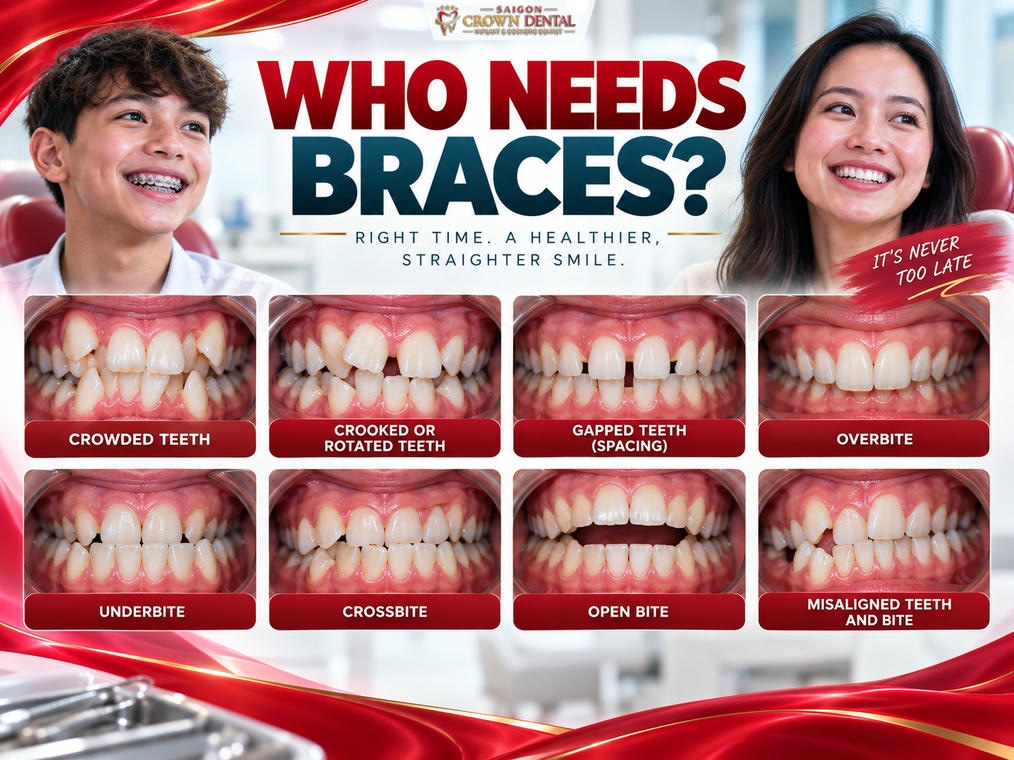
Not everyone needs braces right away. A dentist assesses your specific case first, based on an exam, X-rays, and a 3D scan of your jaw, before recommending any method. The signs vary by age, but the pattern is usually easy to spot once you know what to look for.
-
For children and teens
Braces are often recommended once most adult teeth have come in, typically between ages 10 and 14. Catching alignment issues at this stage usually means a shorter, more predictable treatment, since the jaw is still developing.
-
For adults
The need is usually driven by teeth that have shifted over time, old orthodontic work that’s relapsed, or a bite problem that was never treated. Adult braces work just as effectively – they simply tend to take a little longer, since the jawbone has fully matured.
Common signs it’s worth getting a consultation sooner rather than later:
-
Crowded or crooked teeth
Where teeth overlap or twist out of alignment
-
Noticeable overbite or underbite
Where the upper or lower jaw sits too far forward
-
Visible gaps between front teeth
Which can affect both appearance and speech
-
Difficulty cleaning teeth
Because of misalignment, especially in tightly packed areas
-
Jaw joint pain when chewing
A sign your bite may be under strain
-
Teeth that have shifted after previous braces
Without a retainer to hold them in place
If any of these sound familiar, an early check-up helps identify the right treatment plan before the misalignment becomes more complex – and before it starts affecting more than just how your smile looks.
Risks of delaying braces
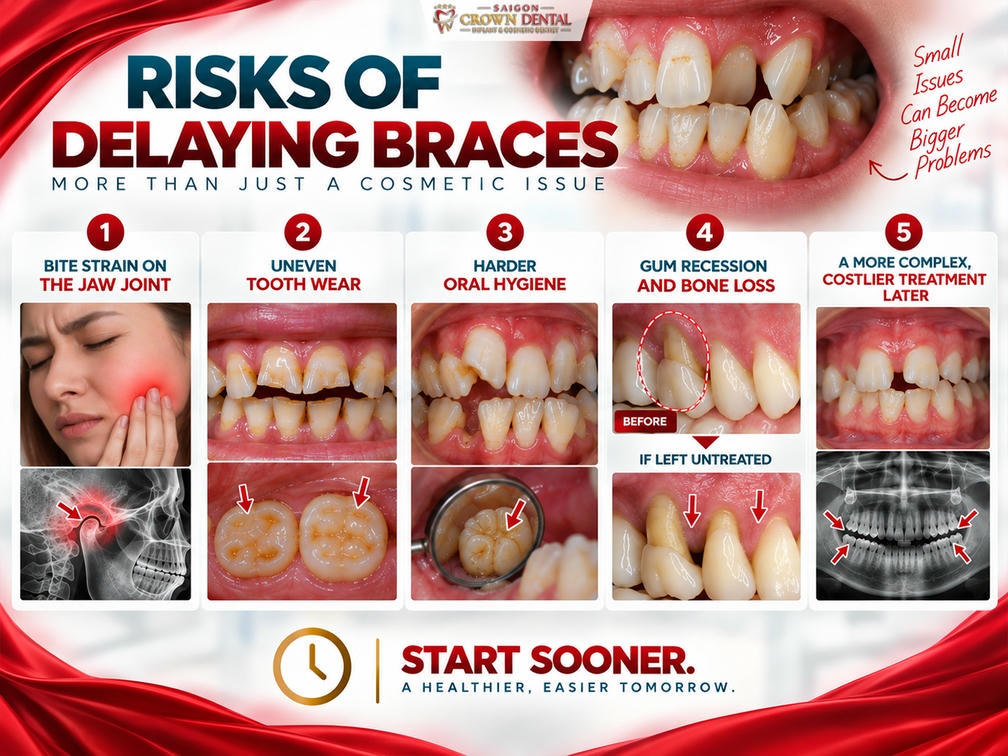
Many people put off braces because they assume it’s purely a cosmetic decision. In reality, delaying treatment can lead to consequences that go well beyond appearance, and most of them get harder to reverse the longer they’re left alone.
Left untreated, a misaligned bite tends to cause:
-
Ongoing bite strain on the jaw joint.
Your jaw compensates for the misalignment every time you chew, which can lead to chronic pain, clicking, or stiffness in the jaw joint over time.
-
Uneven tooth wear.
Chewing force doesn’t distribute evenly across crooked teeth, so certain teeth take on more load than they’re built for – wearing down faster than they should.
-
Harder oral hygiene.
Crowded or overlapping teeth create tight spaces that are difficult to brush and floss properly, raising the risk of cavities and gum disease exactly where it’s hardest to catch early.
-
Gum recession and bone loss.
Teeth that sit outside the normal arch can push against thinner gum tissue, which may recede over time and, in more advanced cases, affect the bone supporting the tooth.
-
A more complex, costlier treatment plan later.
Teeth and jawbone don’t stay still – they continue shifting over time, so a case that’s straightforward today can require a longer, more involved treatment plan a few years down the line.
Because of this, starting treatment earlier usually means a simpler, faster, and more affordable path overall – and it avoids turning a manageable alignment issue into a bigger dental problem later on.
The braces process at Saigon Crown Dental
Many patients want to know exactly how many trips to the clinic they’ll need – especially those living abroad or visiting Vietnam for a short stay. That’s why we map out a clear treatment plan from your very first visit.
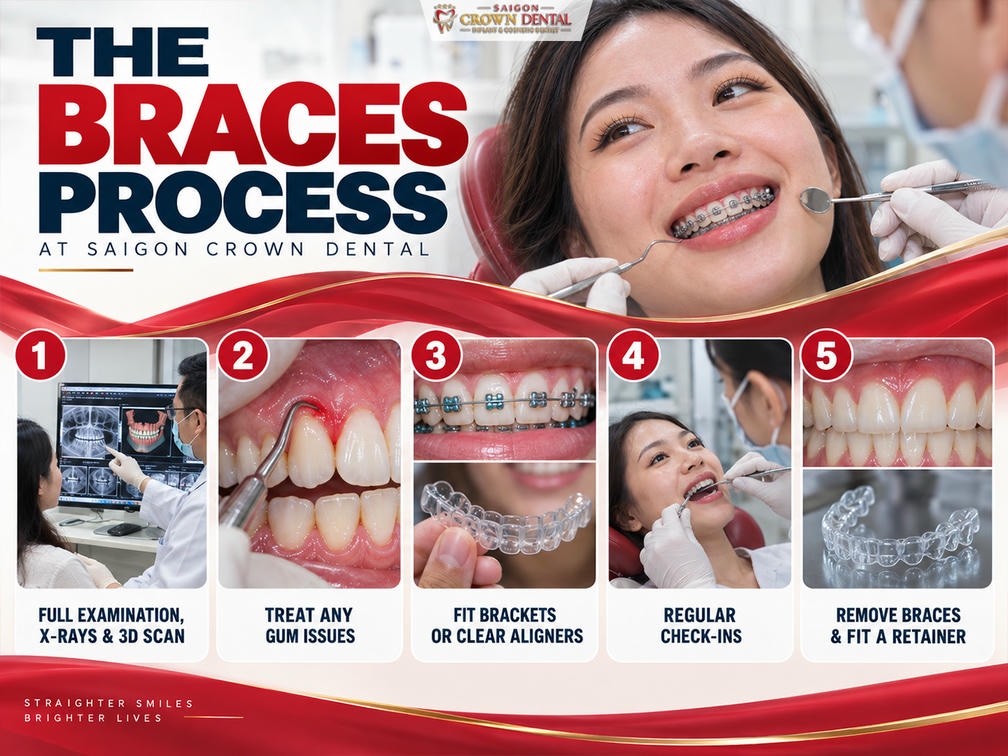
The braces process follows these steps:
- Full examination, X-rays, and a 3D scan of your jaw
- Treating any existing gum issues before braces are fitted
- Fitting your brackets or first set of clear aligner trays
- Regular check-ins every 4-6 weeks
- Removing the braces and fitting a retainer once treatment is complete
Remote monitoring for patients living abroad
This is Saigon Crown Dental’s biggest differentiator. With clear aligners, you send progress photos or videos through Zalo or WhatsApp at regular intervals. Your dentist reviews your progress and adjusts your treatment plan remotely.

How long does braces treatment take?
This is usually the second most common question after cost, especially for patients who are busy or living overseas. Treatment length depends on how severe your misalignment is and which method you choose.
Overall, braces treatment runs 12 to 24 months. Metal and ceramic braces typically take 18-24 months, while clear aligners can finish sooner – from around 12 months, depending on your case.
With clear aligners, remote monitoring significantly cuts down how often you need to be at the clinic in person. Most patients only need to return to Vietnam at key milestones, rather than checking in every 4-6 weeks the way traditional braces require.
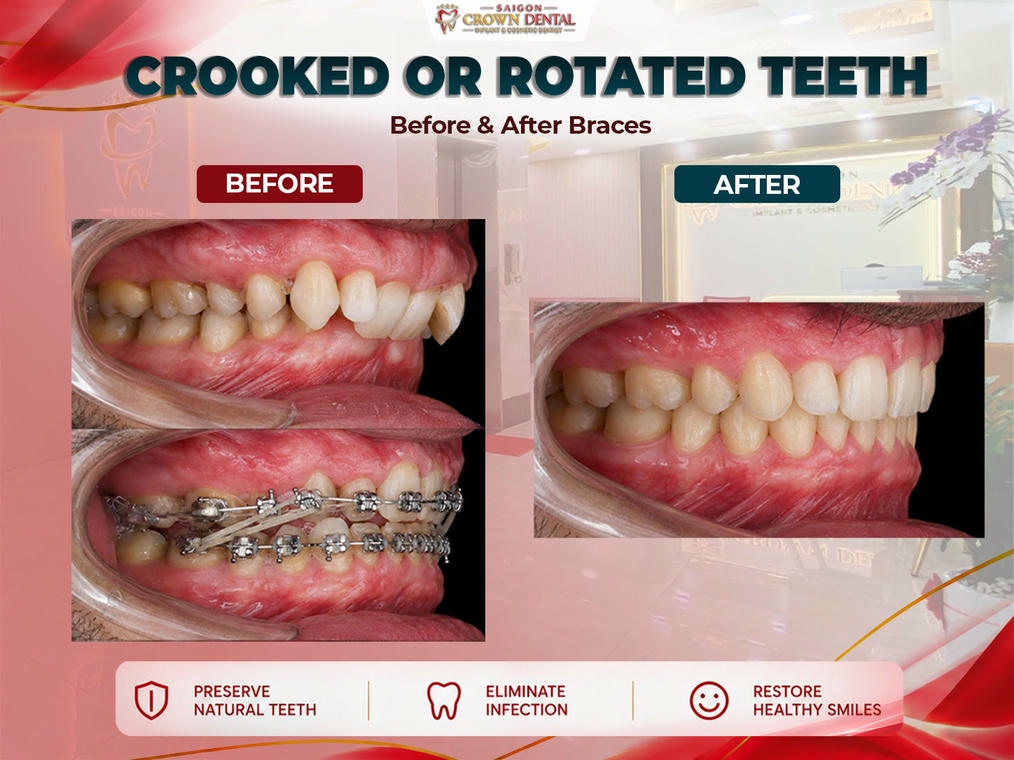
Real patient results
Braces results aren’t only about straighter teeth. Many patients report easier chewing and more confidence in daily conversations once treatment is complete.
|
Before Braces |
After Braces |
|
Crowded teeth, hard to clean |
Straight teeth, easier to clean |
|
Misaligned bite, uneven chewing |
Balanced bite, comfortable chewing |
|
Hesitant to smile due to overbite/underbite |
More confident in everyday interactions |
|
Higher risk of cavities in crowded areas |
Lower risk of cavities and gum disease |
-
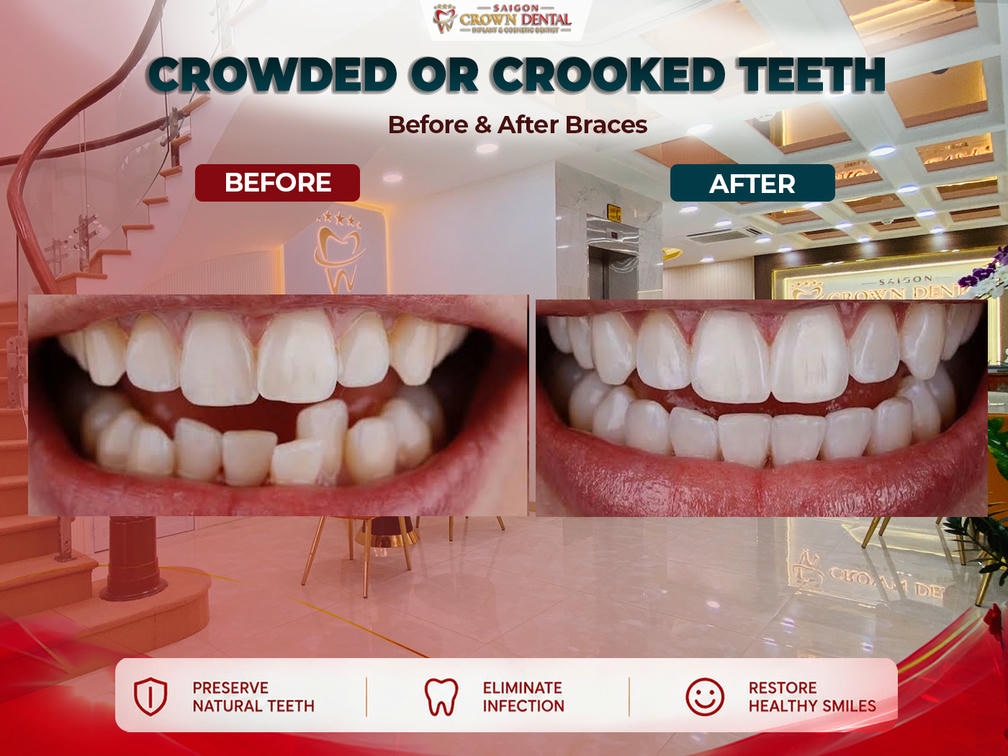
Case 1: Lower Arch Crowding
Initial condition: Moderate crowding of the mandibular incisors; the teeth were inclined lingually, making oral hygiene difficult.
Treatment: Metal braces were used to align and level the dental arch.
Result: The crowding was resolved, the Curve of Spee was leveled, and a harmonious mandibular arch was achieved.
-
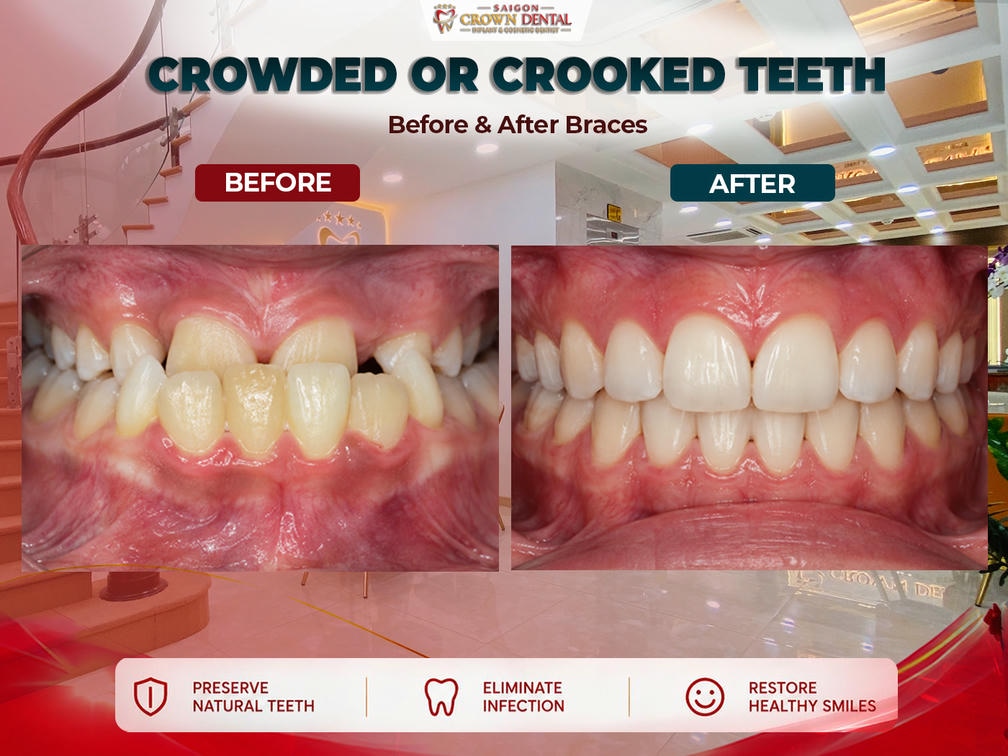
Case 2: Severe Generalized Crowding
Initial Presentation: Severe multi-arch crowding and irregular axial inclination associated with localized mild gingival inflammation.
Treatment : Comprehensive fixed appliance mechanics coupled with arch expansion and controlled leveling.
Clinical Improvement: Transverse arch coordination, complete alignment of severely displaced teeth, and restoration of periodontal-friendly contact points.
-
Case 3: Upper Anterior Crowding
Initial Presentation: Overlapping maxillary anterior teeth narrowing the smile corridor.
Treatment : Space creation via fixed bracket alignment and torque control.
Clinical Improvement: Aligned maxillary incisors, flattened occlusal plane, and broadened buccal corridors.

-
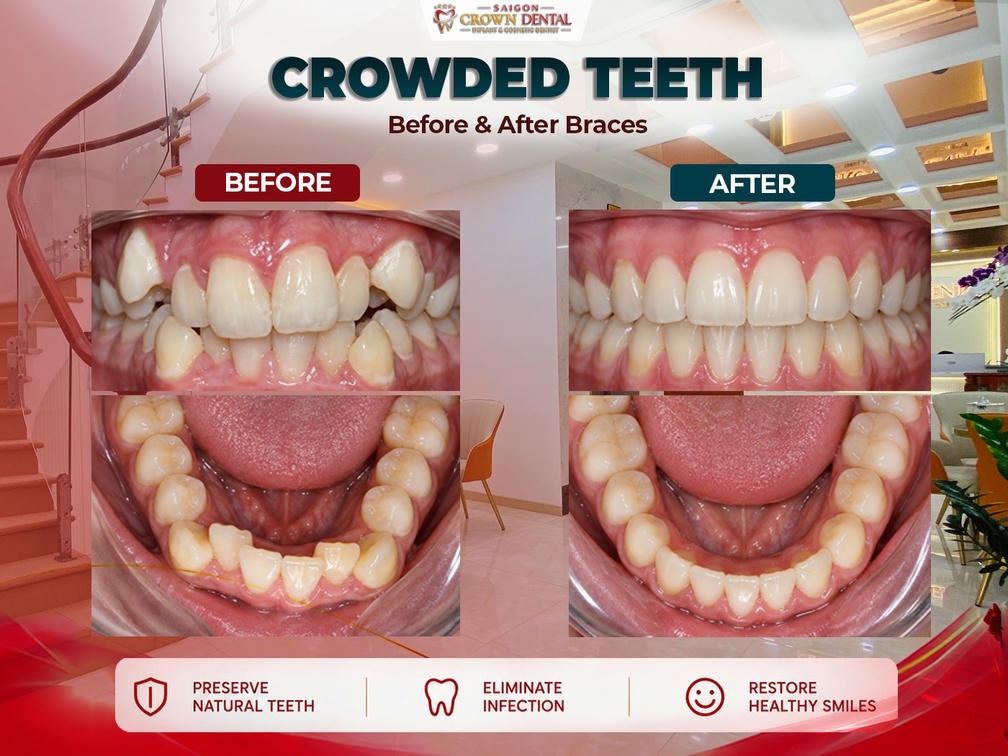
Case 4: Full Arch Constriction & Crowding
Initial Presentation: Constricted dental arches with rotated and overlapping anterior units.
Treatment : Arch form expansion and multi-step leveling with fixed appliances.
Clinical Improvement: Achieved symmetrical arch forms and ideal intercuspidation.
-
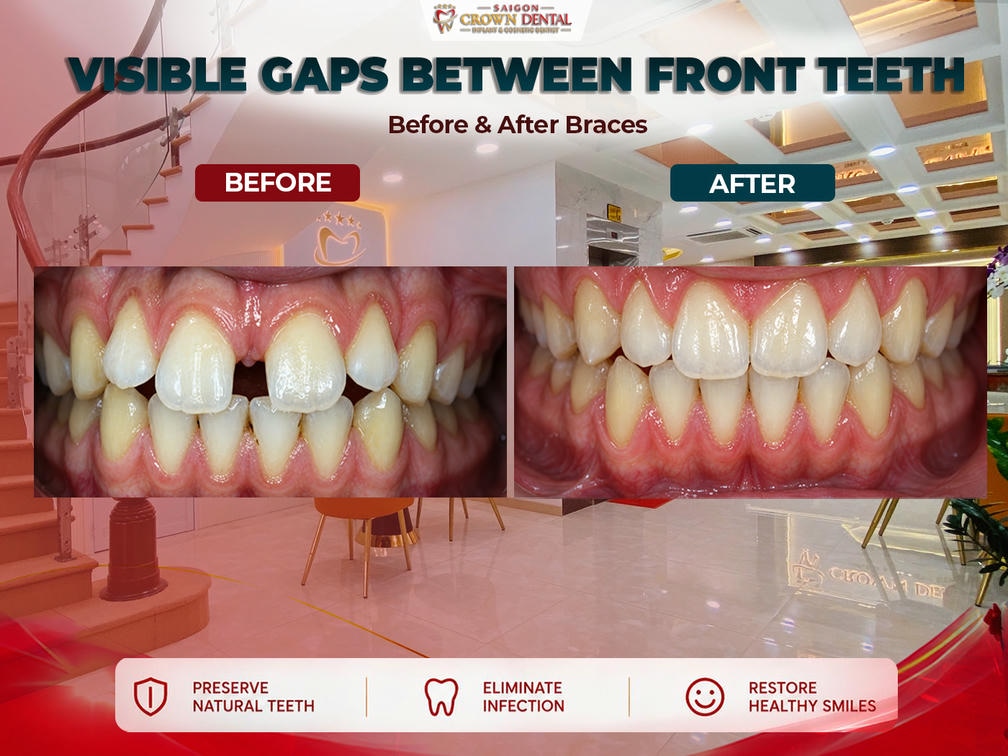
Case 5: Maxillary Midline Diastema
Initial Presentation: Wide spacing (diastema) disrupting anterior esthetics.
Treatment: Closed-loop or sliding mechanics with light continuous forces for bodily space closure.
Clinical Improvement: Complete elimination of the midline gap and symmetrical dental midline coincidence with facial midline.
-
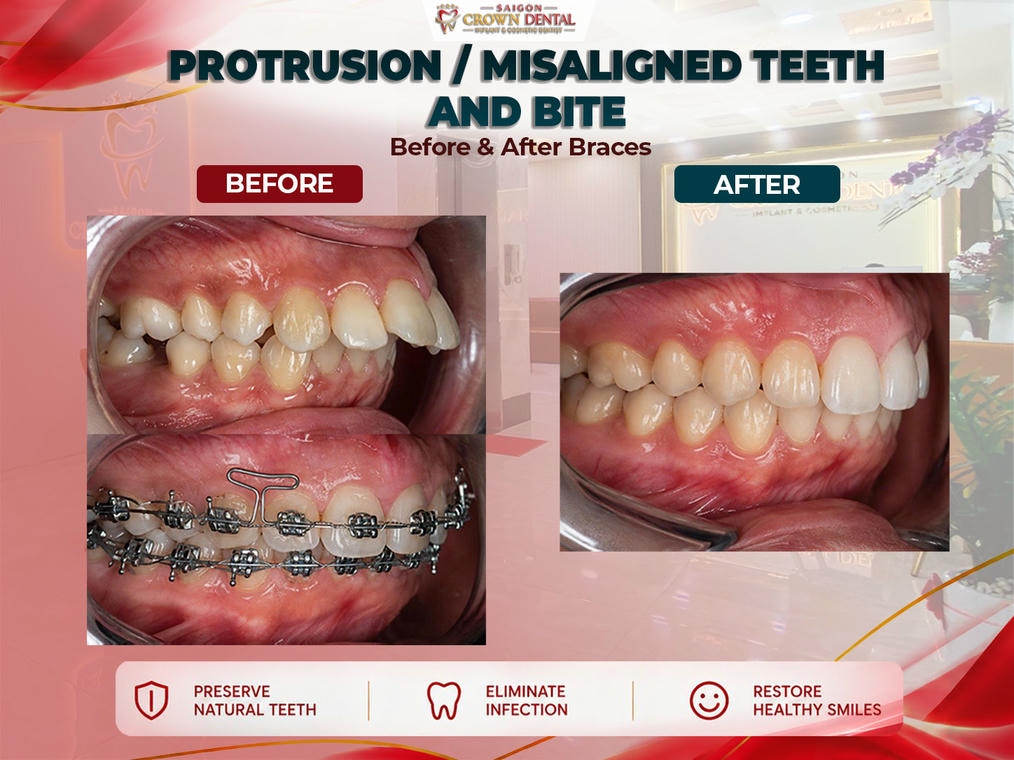
Case 6: Protrusion & Malocclusion
Initial Presentation: Maxillary anterior protrusion (excessive overjet) and skeletal-dental discrepancy under active fixed appliance treatment.
Treatment: Anterior retraction mechanics and vertical control using fixed appliances.
Clinical Improvement: Reduced overjet, repositioned anterior teeth into proper sagittal inclination, and stabilized bite relationship.
-
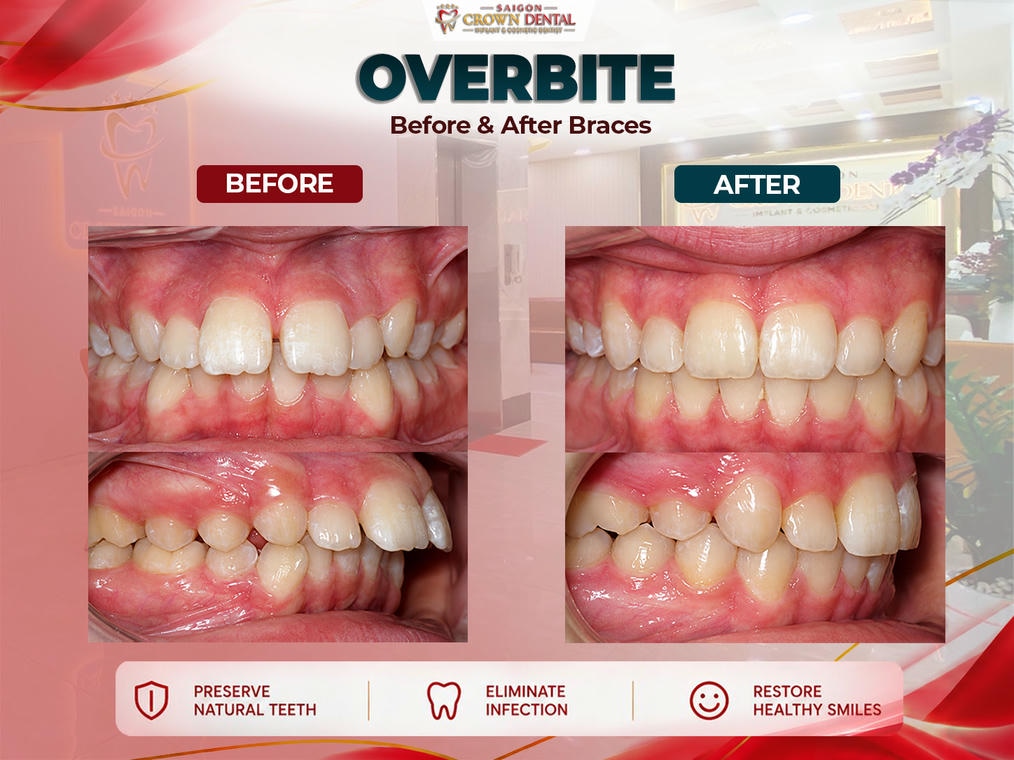
Case 7: Deep Overbite
Initial Presentation: Deep vertical overlap where maxillary incisors obscure lower incisors excessively.
Treatment : Intrusion of anterior segments and/or extrusion of posterior segments via fixed orthodontics.
Clinical Improvement: Normalized vertical overbite percentage and protected periodontal health of opposing gingiva.
-
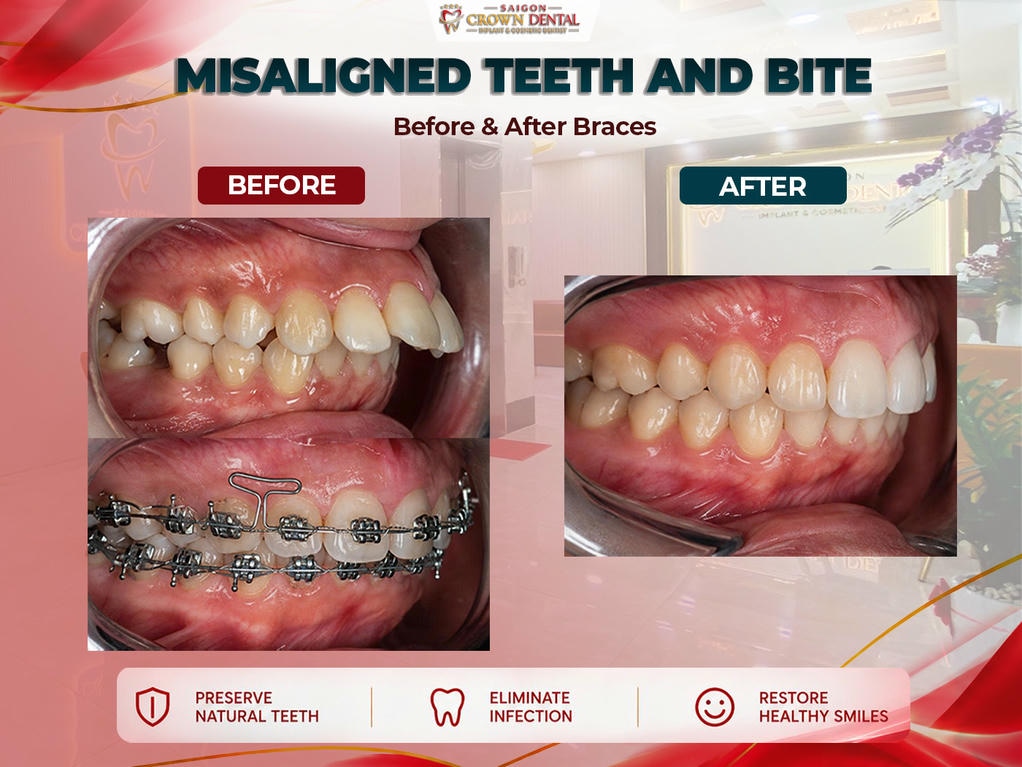
Case 8: Occlusal Malalignment
Initial Presentation: Transverse and vertical occlusal discrepancies under active fixed appliance intervention.
Treatment : Intermaxillary relationship refinement and finishing archwire coordination.
Clinical Improvement: Synchronized occlusal contact points and balanced functional occlusion.
-
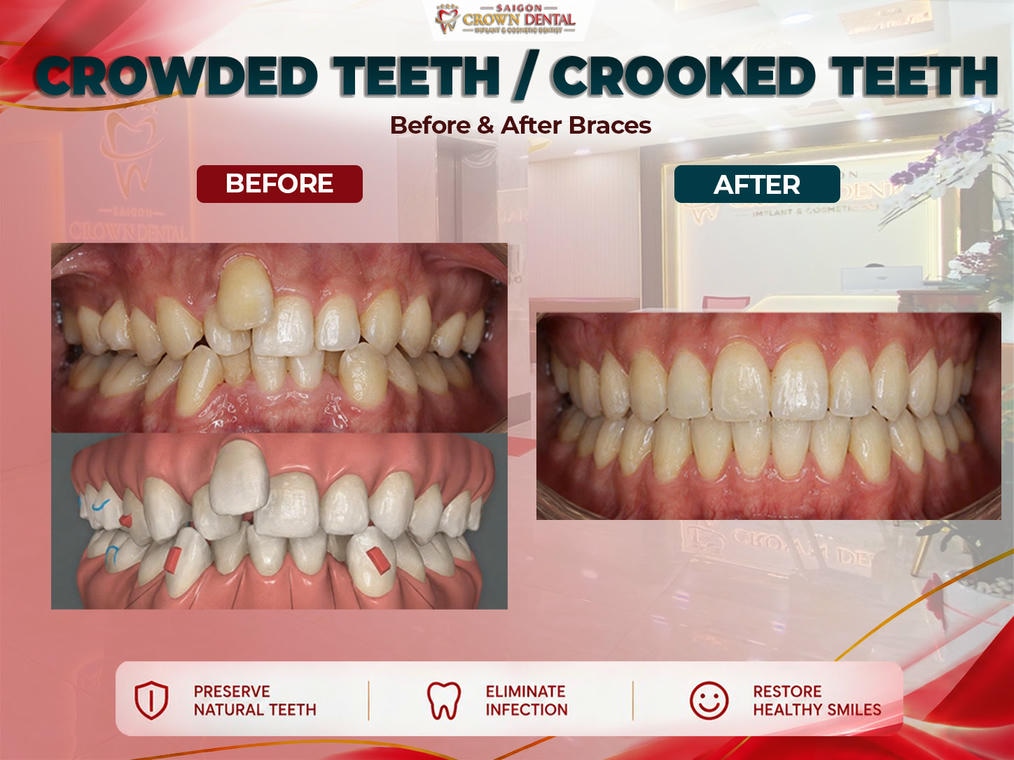
Case 9: Severe Ectopic Crowding
Initial Presentation: Ectopic eruption and severe displacement of anterior teeth outside the normal arch line.
Treatment : Sequential alignment, space management, and leveling with fixed appliances.
Clinical Improvement: Flattened occlusal plane and brought ectopic teeth into proper dental arc.
-
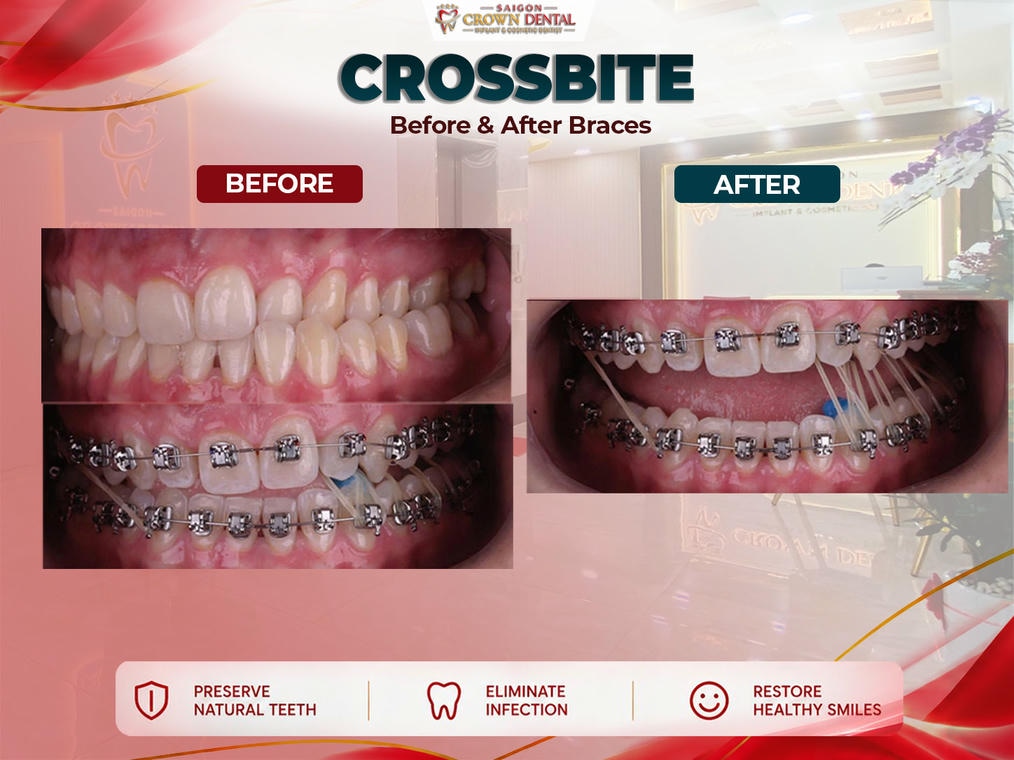
Case 10: Crossbite Management
Initial Presentation: Transverse crossbite relationship managed via fixed appliances and intermaxillary elastics.
Treatment : Cross-elastics and transverse expansion mechanics to reverse palatal/buccal inversion.
Clinical Improvement: Eliminated crossbite interference, achieving normal transverse overjet/overbite cross-protection.
-
Case 11: Multi-Tooth Rotation & Displacement
Initial Presentation: Complex rotational anomalies and vertical displacement under active fixed appliance and elastic traction phase.
Treatment : Precision torque, individual tooth rotation couples, and elastic-assisted vector correction.
Clinical Improvement: Complete correction of axial rotations, aligned marginal ridges, and functional stability.
Braces cost: transparent pricing
The most common question about braces is simply “how much does it cost?” Many patients have been quoted a low starting price elsewhere, only to face extra fees later. That’s why our pricing is published upfront, in full.
The pricing below covers the consultation, fitting, and all regular check-ins. There are no hidden costs added mid-treatment.
|
Method |
Full Package Cost (USD) |
Treatment Time |
|
Metal braces |
$800 – $1,500 |
18 – 24 months |
|
Ceramic braces |
$1,200 – $2,200 |
18 – 24 months |
|
Clear aligners |
$2,500 – $4,500 |
12 – 24 months |
Reference pricing, excludes VAT, and may be adjusted after an in-person consultation.
Why choose Saigon Crown Dental
International patients are often wary of a clinic’s actual expertise, especially when English-language marketing doesn’t always match the quality behind it. That’s why Saigon Crown Dental is transparent about our dentists’ credentials and safety standards, rather than asking you to take it on faith.
-
Experienced dentists.
Our orthodontists have treated both local and international braces patients for years, across everything from straightforward alignment cases to more complex bite corrections – so your case isn’t the first of its kind they’ve handled.
-
A tooth-preservation philosophy.
Braces are recommended precisely because they don’t require shaving down healthy enamel the way veneers or crowns do – in line with the clinic’s broader approach of only intervening where it’s genuinely needed, and preserving natural tooth structure everywhere else.
-
Fluent English communication.
You’re consulted directly by a dentist who speaks English fluently, not through a translator. That matters most when it comes to understanding exactly what your treatment involves and why.

-
Transparent pricing.
Your full cost is published and confirmed at your very first consultation, in writing. There are no hidden fees added once treatment has already started.
-
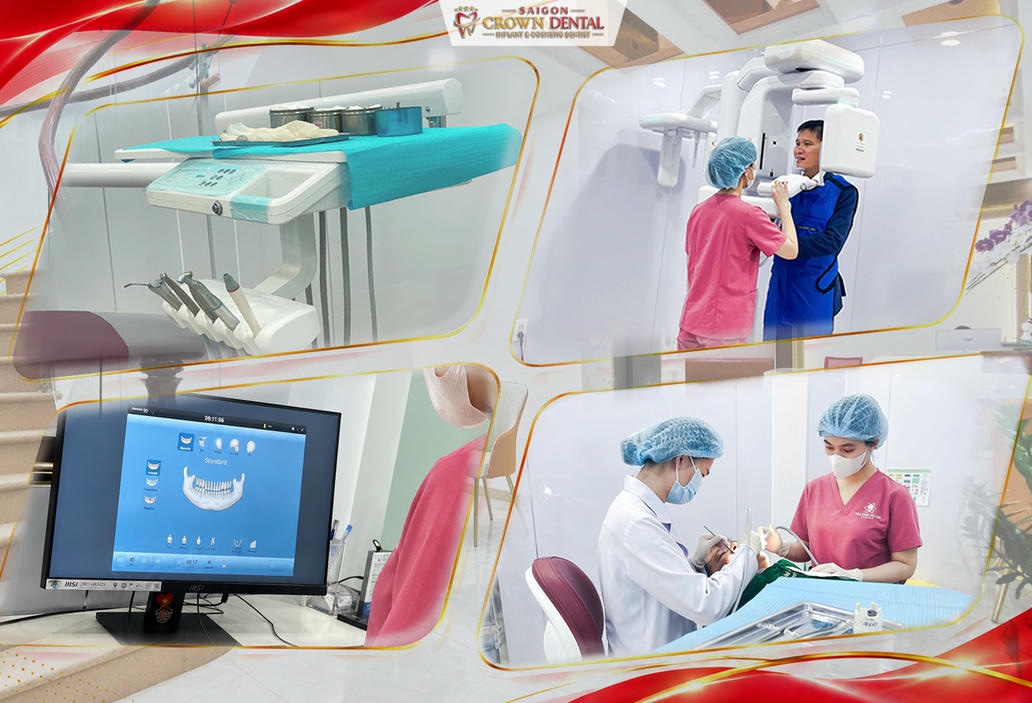
3D jaw scanning technology.
Every treatment plan is built from a detailed 3D scan of your jaw, not a visual estimate – so your bracket or aligner plan is mapped precisely from day one.
-
Central Ho Chi Minh city location.
The clinic is easy to reach from where most visitors and expats are based in the city, so appointments don’t turn into a logistical headache.
Together, these aren’t just features – they’re what most patients say made the difference between researching braces online and actually committing to treatment.

Support for international patients
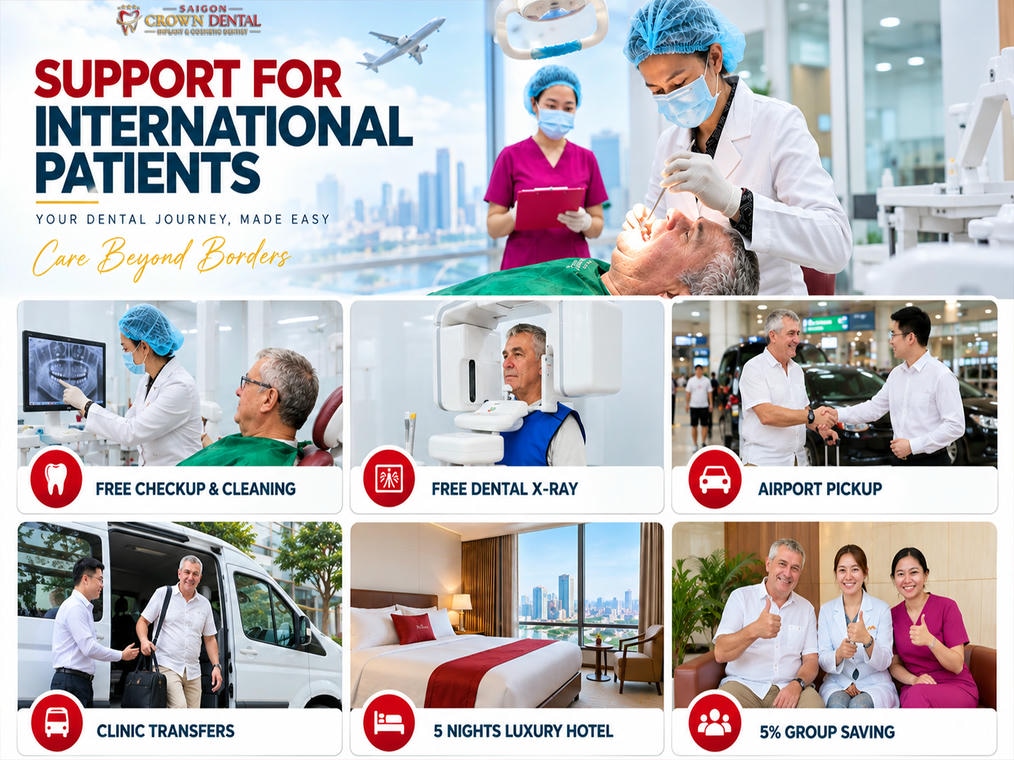
Patients living abroad often struggle to fit braces treatment around their travel schedule, more than around the treatment itself. Saigon Crown Dental builds a dedicated support package around this, so your journey runs smoothly well beyond the treatment chair.
-
A visit plan built around your travel schedule.
Before treatment starts, you’ll know exactly which visits are essential and when – so you can plan trips home around your care, instead of the other way around.
-
Remote progress monitoring
Via photos and video sent through Zalo or WhatsApp. Your dentist reviews your progress and flags anything that needs attention, cutting down how often you need to fly back in person.
-
Hotel booking support
For the visits you do need to make, so accommodation is one less thing to arrange yourself while coordinating treatment.
-
Airport pickup
So you’re taken care of from the moment you land in Ho Chi Minh City, rather than navigating an unfamiliar city straight off a long flight.
This package exists because clinical quality alone isn’t enough for patients coordinating treatment across borders – the logistics need to be just as dependable as the dentistry.
Frequently asked questions
-
Do braces hurt?
You may feel mild tightness for the first few days. This usually eases within 2-3 days.
-
What if I fly home mid-treatment?
With clear aligners, your dentist monitors your progress remotely through photos and video. You only need to return for key milestones.
-
Will treatment take exactly as long as estimated?
Treatment time is estimated based on your actual misalignment. Your dentist will let you know right away if anything changes during treatment.
-
Are there any costs beyond the published price?
No. Any additional cost is confirmed in writing before it’s carried out.
Ready to start your braces journey?
Braces treatment is a long journey that depends on trust between you and your dentist. That’s why it’s worth choosing a clinic with clear pricing and a transparent process from day one. Whether you’re considering clear aligners or traditional braces, the team at Saigon Crown Dental is ready to recommend the right plan for your teeth and your schedule – one that straightens your smile without sacrificing the natural tooth structure you already have.